
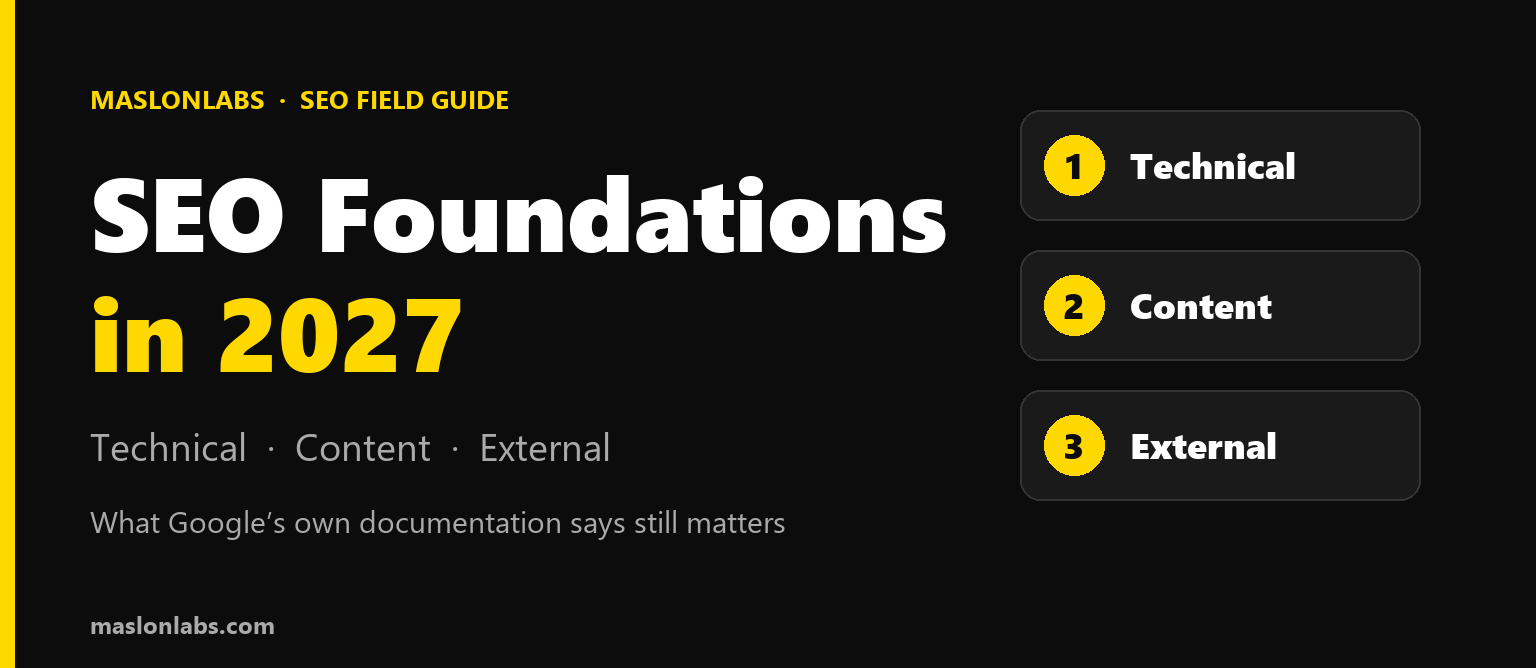
Every few months a new acronym arrives and SEO is declared obsolete or reinvented. Underneath the noise, the things that decide whether a page can rank have barely moved: Google has to be able to reach it, the page has to deserve attention, and other people have to point to it. This guide covers those three layers — technical, content and external — using Google’s own documentation as the source of truth, with my notes on what actually matters when you do the work.
“
Most SEO problems I see are not advanced. A page Google cannot reach, a page that does not answer the question, a brand nobody mentions. Fix those three before you touch anything clever.
— Mateusz Maslon, SEO/GEO Specialist 🎯
LinkedIn ↗
Quick Answer: What Are the Foundations of SEO?
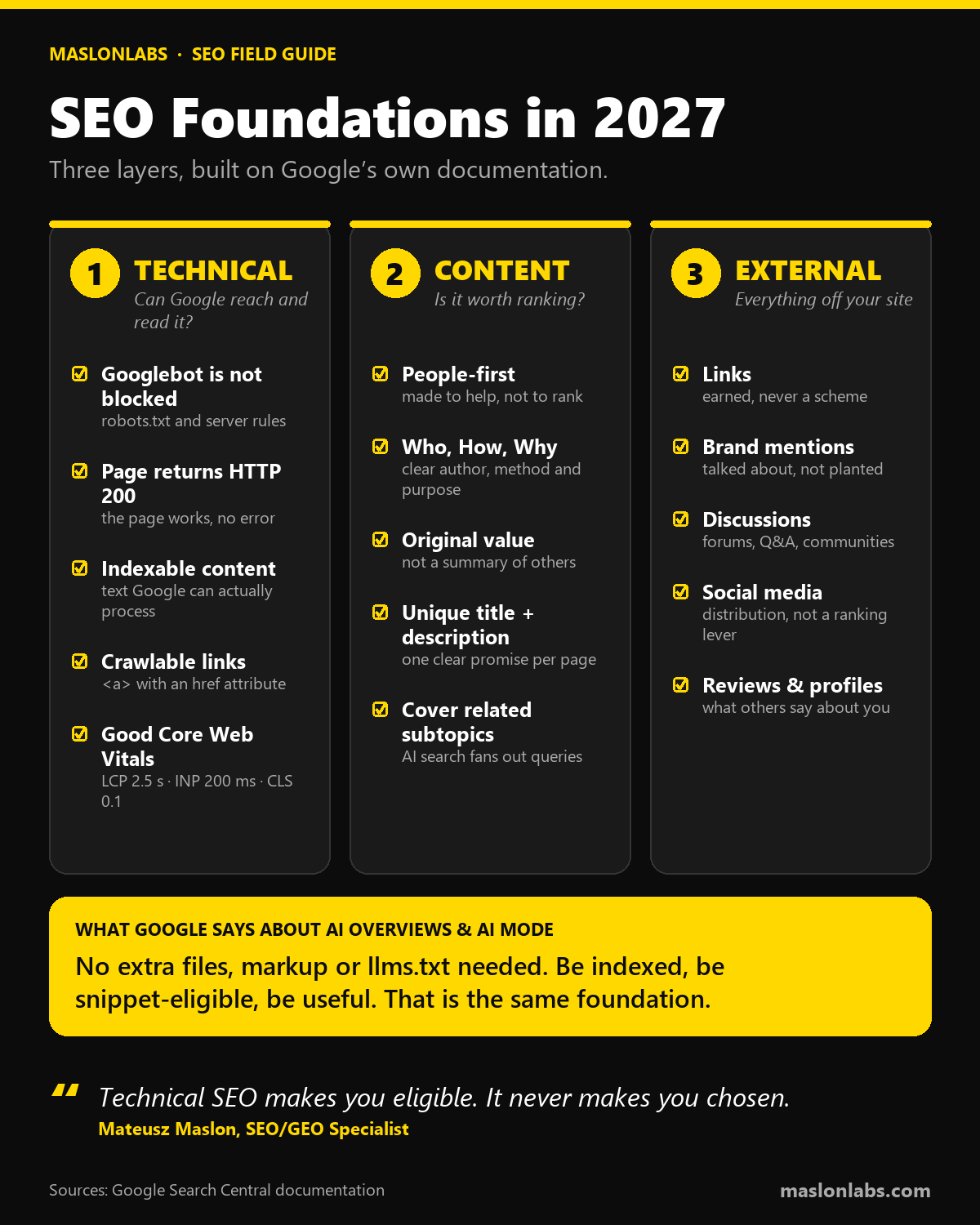
SEO foundations are three layers that build on each other. Technical makes your pages crawlable and indexable. Content makes them worth ranking. External signals — links, mentions, discussions and social media, everything off your site — show that people vouch for you. Google’s documentation says the same about AI Overviews and AI Mode: there are no additional requirements and no special optimizations beyond being indexed and eligible to show a snippet.
Why SEO Foundations Still Decide Everything in 2027
New search surfaces keep appearing — AI Overviews, AI Mode, chat assistants that cite sources. The reasonable question is whether they need a new playbook. For Google’s own AI features the answer in its documentation is blunt: “There are no additional requirements to appear in AI Overviews or AI Mode, nor other special optimizations necessary.” The page must be indexed and eligible to appear in Search with a snippet, and that is it. Google also says you do not need new machine-readable files, AI text files, or special schema.org markup for these features.
Two details are worth knowing. First, these features may use query fan-out: they run several related searches across subtopics and data sources, which is why they can surface a wider set of links than classic search. A page that covers its topic properly has more chances to be pulled in. Second, AI Overviews and AI Mode traffic is counted inside the normal Web results of your Search Console Performance report — there is no separate switch to flip (we cover the reporting side in tracking AI performance in Google Search Console).
“
Every few months someone announces that AI search needs a brand-new discipline. Then you read the documentation and it says: indexed, snippet-eligible, useful. That is foundations.
— Mateusz Maslon, SEO/GEO Specialist 🎯
LinkedIn ↗
If you want the AI-specific angle on top of this, see our GEO guide and the comparison in SEO vs. GEO. This article is the layer underneath both.
Pillar 1: Technical SEO — Can Google Reach and Read Your Pages?
Technical SEO is about eligibility. Google lists three minimum technical requirements for a page to be indexed:
- Googlebot is not blocked.
- The page works, meaning Google receives an HTTP 200 (success) status code.
- The page has indexable content.
Meeting them does not guarantee indexing, but missing one guarantees you are out. Beyond that baseline, five things deserve attention.
1. Crawlable links
Google generally crawls links that are an <a> element with an href attribute. It cannot reliably extract URLs from elements without one, and it recommends against javascript: URLs. Anchor text should be descriptive, reasonably concise and relevant; “click here” and “read more” are called out as poor anchor text. If your site renders content with JavaScript, read what crawlers actually see — the answer differs between Googlebot and many AI crawlers.
2. One URL per piece of content
Google recommends reducing duplicate content with 301 redirects or rel="canonical". It also notes there is no duplicate-content “penalty” as such — duplicates are inefficient, and copying other sites’ content is a different matter. Use descriptive URLs rather than random identifiers.
3. Sitemaps are optional, Search Console is not
A sitemap is described as optional: a file listing the URLs you care about. Google mostly discovers pages through links. What you should not skip in practice is Search Console. The URL Inspection tool shows whether Google sees your page the way a user does, including CSS and JavaScript.
4. Core Web Vitals
Google’s thresholds for a good experience are:
| Metric | Measures | Good |
|---|---|---|
| Largest Contentful Paint (LCP) | Loading | within 2.5 seconds |
| Interaction to Next Paint (INP) | Responsiveness | under 200 milliseconds |
| Cumulative Layout Shift (CLS) | Visual stability | under 0.1 |
Google strongly recommends good Core Web Vitals and says they align with what its core ranking systems seek to reward, but does not present them as a standalone ranking factor. Treat them as hygiene: a slow page loses readers before ranking even matters.
5. Structured data: use it for rich results, not as an AI trick
Valid structured data can unlock rich results in classic Search. For AI Overviews and AI Mode, Google states no special schema is needed. Add markup where it describes the page truthfully (an article, a FAQ, a product).
“
Technical SEO is the only pillar where you can be completely right and still get nothing. It makes you eligible. It never makes you chosen.
— Mateusz Maslon, SEO/GEO Specialist 🎯
LinkedIn ↗
Pillar 2: Content — Is the Page Worth Ranking?
Once a page is eligible, content decides whether it deserves to win. Google’s guidance on helpful content is built around people-first content: content created primarily to help people, not to manipulate rankings. Its own warning sign is publishing lots of content on many different topics in the hope that some of it performs.
E-E-A-T: what Google actually says
Google names four qualities — experience, expertise, authoritativeness and trustworthiness (E-E-A-T) — and says that of these, trust is most important. It also says E-E-A-T is not a single ranking factor; Google uses a mix of signals to identify content that shows these qualities, and it matters most for topics that affect people’s health, finances or safety.
Who, How and Why
Google frames content quality around three questions you can answer on any page:
- Who created it? Authorship should be self-evident, and fabricated author profiles are deceptive.
- How was it created? If automation or AI was used, explaining why it was useful is encouraged.
- Why does it exist? To help visitors, not mainly to attract search traffic.
The self-assessment worth running on every page
- Does it provide original information, reporting, research or analysis?
- Is it a page you would bookmark, share with a friend or recommend?
- Is it a substantial, complete description of the topic?
- Is it free of easily verified factual errors?
- Will a reader leave feeling they had a satisfying experience?
- Are you mainly summarizing what others say without adding value?
The last question is the one that matters most for AI search. If an assistant can produce your page from other pages, it has no reason to cite you. Original data, first-hand experience and a clear point of view are what remain. We break this down further in our 9-step checklist for getting cited by AI assistants.
Titles, descriptions and the on-page basics
- Title: unique, clear, concise, and describing the page. It is what Google uses for the title link.
- Meta description: typically a one- or two-sentence summary. It feeds snippets; it is not a ranking lever.
- Structure: headings and short paragraphs make content easier to read and to extract.
- Images: sharp, placed near relevant text, with descriptive alt text.
- Search terms: use the words people actually search for in titles, main headings, alt text and link text, and anticipate variations (“cheese board” vs “charcuterie”).
“
I ask one question before I publish: would I send this to a client? If the answer is no, the page is not ready, however well it matches the keyword.
— Mateusz Maslon, SEO/GEO Specialist 🎯
LinkedIn ↗
Pillar 3: External Signals — Does Anyone Vouch for You?
The third foundation is everything that happens off your website: what other sites, communities and people say about you and where they point. Google does not use the label “off-page” in its documentation, but its guides cover the same ground: the SEO Starter Guide has a whole section on promoting your website, and Search Essentials lists promoting the site in communities where its audience gathers as a key best practice. I split this layer into five elements.
1. Links
Google says it mostly finds pages through links, which is why links are both a discovery mechanism and a signal that someone chose to reference you. The key word is chose: link spam is a named spam policy, defined as creating links to or from a site primarily for the purpose of manipulating search rankings. For links you place yourself, use nofollow (or a similar annotation) on sites you do not trust and on user-generated links such as comments.
2. Brand mentions
A mention is your brand, product or name appearing on another page, with or without a link. Google does not publish a ranking weight for mentions and I will not invent one. In practice I see that independently referenced brands get discovered faster and are the ones AI assistants tend to name when asked for recommendations. That is a pattern from my work, not a documented rule.
3. Discussions and communities
Forums, Q&A sites and subreddits are where people ask which tool or service to trust. Google’s own results show a “discussions and forums” block for many queries, so a thread can be a way into the results page even when your own page is not there yet. Google’s guidance is to take part where your audience already is, and to avoid overpromotion, which it says can look like manipulation.
4. Social media
The SEO Starter Guide lists social media next to community engagement, advertising and word of mouth as ways to promote a site. Treat social platforms as distribution, not as a ranking lever: Google does not document likes or shares as a ranking signal, but social is where content gets seen, shared and linked from.
5. Reviews and profiles
Reviews, directory listings and business profiles are third-party descriptions of who you are. They are also what people read before they trust you, which is why they belong to the external layer even when they carry no link.
“
You cannot fake being talked about. The links and mentions that matter are the ones you did not ask for, and you earn them by being the page other people point to.
— Mateusz Maslon, SEO/GEO Specialist 🎯
LinkedIn ↗
Foundations at a Glance
| Layer | Question it answers | What to do first |
|---|---|---|
| Technical | Can Google reach and read it? | Check indexing in Search Console; fix blocked, erroring or non-indexable pages; use crawlable links |
| Content | Is it worth ranking? | Add a clear author, original value and a unique title and description; run the self-assessment |
| External | Does anyone vouch for it? | Earn links and mentions, join discussions where your audience is, use social media for distribution, collect reviews; avoid link schemes |
Myths You Can Safely Ignore
Google’s SEO Starter Guide has an explicit list of things not to obsess over. The ones I get asked about most:
- Meta keywords: Google Search does not use the keywords meta tag.
- Word count: there is no minimum or maximum content length.
- Keywords in the domain or URL: little ranking effect beyond what they show in breadcrumbs.
- Heading order: Google does not depend on a strict heading hierarchy.
- llms.txt and AI-only files: Google says you do not need new AI text files for its AI features. We looked at the broader evidence in Does llms.txt work?.
- A single “E-E-A-T score”: it is a framework, not one factor.
A Practical Order of Operations
- Verify indexing. Open Search Console, inspect your 5 most important URLs, and confirm they are indexed and return a 200.
- Fix crawlability. Replace JavaScript-only navigation with real links; resolve duplicate URLs with canonicals or 301s.
- Rewrite titles and descriptions for the pages that matter, one clear promise each.
- Run the self-assessment on your top pages and add what only you can: data, screenshots, first-hand experience, a named author.
- Cover the subtopics a reader (or an AI fan-out query) would expect next to the main question.
- Earn external signals by being useful in the communities your audience already uses: discussions, social media, reviews, and sites that choose to link to you.
- Wait and measure. Google says changes can take from a few hours to several months to show up, and suggests waiting a few weeks before judging results.
For a hands-on audit of the same layers, use our 15-point self-audit checklist.
Free tools to check the basics on your own site: the SEO Audit and the GEO Audit.
Related reading: what Crawled – currently not indexed means.
Frequently Asked Questions
What are the foundations of SEO?
Three layers: technical (Google can crawl and index your pages), content (pages are people-first, original and clearly authored) and external signals (everything off your site: links, mentions, discussions, social media, reviews). Each layer builds on the one before it.
What are the pillars of SEO?
Most guides use three pillars – technical, content and off-site – and some split content into on-page and content creation to get four. The underlying requirements are the same either way.
Is SEO still worth it in 2027?
Yes. Google states that AI Overviews and AI Mode have no additional requirements beyond being indexed and snippet-eligible, so the same foundations that earn classic rankings also make you eligible for AI features.
Do I need llms.txt or special schema for AI search?
Not for Google. Its documentation says you do not need new machine-readable files, AI text files or special schema.org markup to appear in AI Overviews or AI Mode.
How long do SEO changes take to work?
Google says changes can take from a few hours to several months to show up, and recommends waiting a few weeks before judging the results.
Does E-E-A-T affect rankings?
Google says E-E-A-T is not a single ranking factor, but that it uses a mix of signals to identify content with these qualities, and that trust is the most important of the four.
Conclusion: Foundations Are the Strategy
Technical SEO makes you eligible, content makes you worth choosing, and external signals make you believable. None of it is new, and none of it expires when a new search interface launches. Go deeper on each layer: Technical SEO Checklist, SEO Content and Off-Page SEO. Choosing a provider? Read How to Choose an SEO Agency. Wondering if any of this still matters? Read Is SEO Dead? for the data. If you only have time for one thing this month, open Search Console and confirm your most important pages are actually indexed — everything else builds on that.
Related reading: choosing a platform? See the best CMS platforms compared for SEO, then track results with these SEO KPIs.