
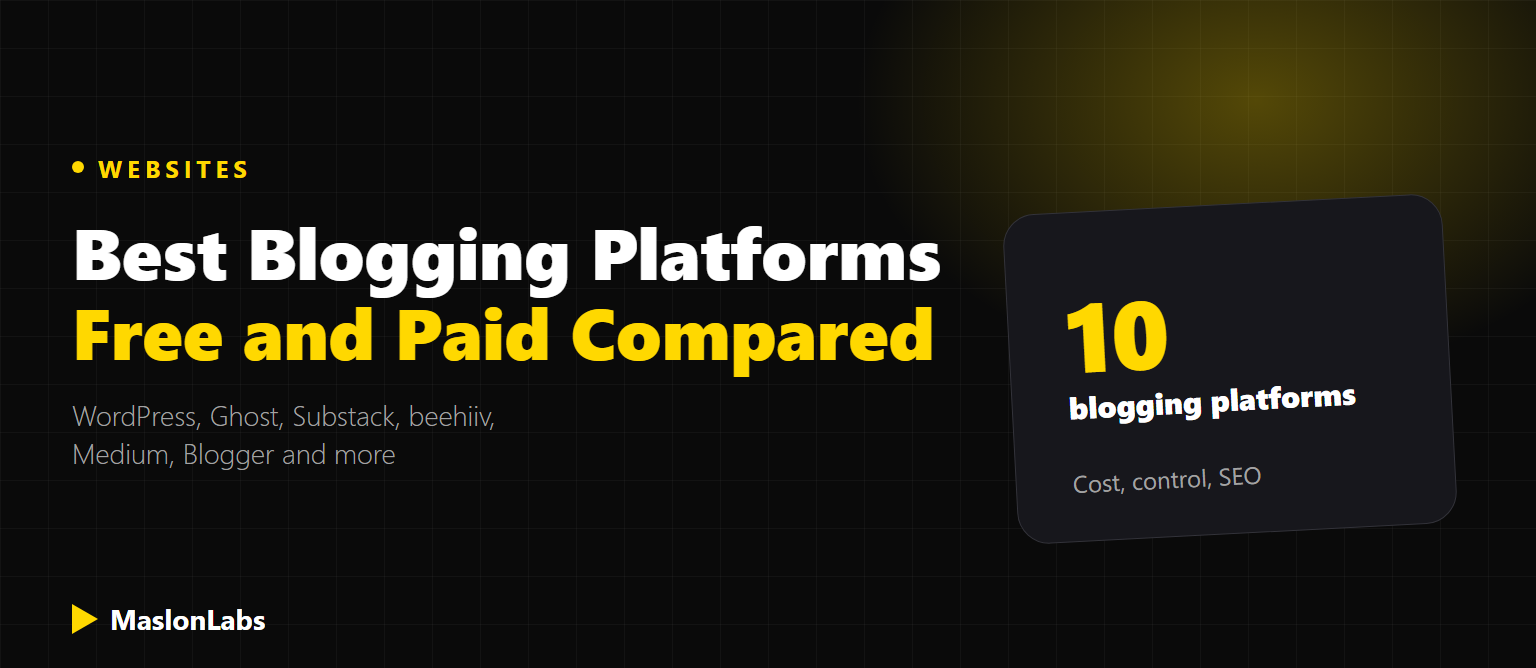
The best blogging platform depends on one question more than any other: do you want to own your blog, or rent space on someone else’s? Self-hosted platforms give you full control and every bit of SEO value; hosted platforms and newsletter tools trade some control for convenience or a built-in audience. We compared ten options in 2026, from WordPress to Substack and beehiiv.
Quick Answer
Self-hosted WordPress is the best blogging platform for most people who want to grow traffic from Google and make money from a blog. Pick Ghost for a fast blog with built-in paid memberships, Substack or beehiiv if your blog is really a newsletter, Medium to write without running a website, and WordPress.com, Blogger or Hashnode to start free.
Prices and plan details were checked on each platform’s official pricing page on November 13, 2026, and are in US dollars.
The Best Blogging Platforms Compared
| # | Platform | Best for | Free option | Own domain | SEO control |
|---|---|---|---|---|---|
| 1 | WordPress.org (self-hosted) | Serious blogs, SEO, monetization | Software free; pay for hosting | Yes | Full |
| 2 | WordPress.com | Starting with WordPress without hosting | Yes | Paid plans | Good on paid plans |
| 3 | Ghost | Blogs with paid memberships | Self-hosted only | Yes | Strong |
| 4 | Substack | Newsletter-first writers | Yes | Optional | Limited |
| 5 | beehiiv | Growing a newsletter business | Yes, up to 2,500 subscribers | Paid plans | Good |
| 6 | Medium | Writing without a website | Yes | Mostly on Medium | Minimal |
| 7 | Wix | A blog inside a business website | Yes (Wix branding) | Paid plans | Good |
| 8 | Squarespace | Design-led personal or portfolio blogs | Trial only | Yes | Basic to good |
| 9 | Blogger | Free, simple hobby blogs | Yes | Yes | Basic |
| 10 | Hashnode | Developer and tech blogs | Yes | Pro plan | Good |
1. WordPress.org: Best Overall Blogging Platform
Self-hosted WordPress is free, open-source software you install on your own hosting. It’s what most professional blogs run on, because nothing limits you: any theme, any plugin, any ad network or affiliate program, and full ownership of your content and domain.
- SEO: the most control of any platform, with plugins such as Yoast SEO or Rank Math for titles, sitemaps, schema and redirects
- Cost: the software is free; you pay for hosting and a domain
- Watch out for: you handle updates, backups and security yourself (or pay a managed host to)
2. WordPress.com: Best Easy Start With WordPress
WordPress.com is the hosted version: same editor, no server to manage. The Free plan has no expiration date but runs on a WordPress.com address. Paid plans start with Personal at $4/month billed yearly ($9 month to month), and the official pricing page lists access to WordPress plugins on all paid plans.
- Best for: beginners who might move to self-hosted WordPress later
- Watch out for: the free plan has no plugins or custom domain
3. Ghost: Best for Blogs With Paid Memberships
Ghost is an open-source publishing platform with newsletters, free and paid memberships built in. On its hosted service, Ghost(Pro), plans start at $18/month billed yearly (Starter, up to 1,000 members, without paid subscriptions); paid memberships start on the Publisher plan. Ghost charges 0% transaction fees on subscriptions, so you only pay the payment processor. Every plan includes a custom domain.
- SEO: fast, clean pages with meta fields, structured data and sitemaps built in
- Watch out for: fewer themes and integrations than WordPress
4. Substack: Best for Newsletter-First Writers
Substack combines a simple blog with an email newsletter and paid subscriptions, plus a network and app where readers discover new writers. Starting is free; when you charge for subscriptions, Substack says writers “keep 90% of their revenue minus credit card fees”, so it takes a 10% cut.
- Best for: writers whose audience reads by email
- Watch out for: limited design and SEO control; the 10% fee adds up as you grow
5. beehiiv: Best for Growing a Newsletter Business
beehiiv is a newsletter platform with a web archive that works as a blog, plus growth and monetization tools. Its Free plan is “free, forever” for up to 2,500 subscribers, and beehiiv takes 0% of paid subscription revenue (Stripe’s processing fee still applies). Paid plans start with Lite at $49/month billed yearly.
- Best for: creators who want to keep all subscription revenue
- Watch out for: built for newsletters first; a weaker fit for evergreen, search-driven blogs
Want your blog to get traffic from Google and AI search?
Get a Free SEO & GEO Audit →6. Medium: Best for Writing Without a Website
Medium is a publishing network rather than a website builder: you sign up and write, and your stories can reach readers who already use Medium. It also runs a Partner Program that pays writers based on how members engage with their stories (check Medium’s help center for current eligibility rules).
- Best for: testing ideas and reaching readers without any setup
- Watch out for: your posts build Medium’s domain authority, not yours, and you can’t customize design or SEO much. Many writers publish on their own site first and republish on Medium with a canonical link back
7. Wix: Best for a Blog Inside a Business Website
If the blog is one part of a business site, Wix lets you build both in one drag-and-drop editor, with hosting included. Its blog tools cover categories, SEO settings per post and scheduling. The free plan shows Wix branding and uses a Wix address.
8. Squarespace: Best for Design-Led Blogs
Squarespace offers some of the most polished templates, which suits photographers, creatives and personal brands who want their blog to look good with little effort. SEO basics are covered, but there’s less room for advanced optimization than on WordPress.
9. Blogger: Best Free Platform for Hobby Blogs
Google’s Blogger has been around since 1999 and is still a no-cost way to start a simple blog. It connects to Google AdSense and Analytics, and you can add a custom domain. Templates and features haven’t kept pace with modern platforms, so it’s best for personal or hobby blogs.
10. Hashnode: Best for Developer Blogs
Hashnode is a free blogging platform popular with developers, with unlimited articles on a hashnode.dev address and Markdown-friendly writing. A custom domain needs the Pro plan ($5/month per seat).
How to Choose: Own Your Blog or Rent It?
| Own (WordPress.org, Ghost) | Hosted builder (WordPress.com, Wix, Squarespace) | Network (Medium, Substack) | |
|---|---|---|---|
| Control | Full | Medium | Low |
| SEO value | All yours | Yours, with some limits | Mostly the platform’s |
| Built-in audience | No | No | Yes |
| Maintenance | You (or your host) | Handled for you | None |
| Monetization | Anything you like | Depends on the plan | The platform’s rules and fees |
If search traffic is your plan, own your blog and your domain from day one: moving later means redirects and a temporary dip in rankings. For the technical side, see our technical SEO checklist and our guide to SEO content.
Building a full website rather than just a blog? Compare the best CMS platforms, or see the best WordPress alternatives if WordPress isn’t for you.
Frequently Asked Questions
What is the best blogging platform?
Self-hosted WordPress is the best blogging platform for most people who want search traffic and full control. Ghost is best for paid memberships, and Substack or beehiiv for newsletter-first writers.
What is the best free blogging platform?
WordPress.com, Blogger, Medium, Substack, Hashnode and beehiiv (up to 2,500 subscribers) all have free options. For long-term growth, a self-hosted WordPress blog costs only hosting and a domain.
Which blogging platform is best for SEO?
Self-hosted WordPress, because you control titles, URLs, sitemaps, schema and redirects and build authority on your own domain. Ghost is also strong for SEO out of the box.
Is Substack or beehiiv better?
Substack is simpler and has a built-in reader network, but takes 10% of paid subscription revenue. beehiiv takes 0% of subscription revenue and offers more growth tools, with a free plan up to 2,500 subscribers.
Is Medium good for blogging?
Medium is good for reaching readers without building a website, but your posts mainly build Medium’s domain rather than your own. Many writers publish on their own site and republish on Medium.
Is Blogger or WordPress better?
WordPress is better for almost every serious blog thanks to its themes, plugins and SEO control. Blogger is a simple, free option for hobby blogs.