
Type “SEO vs GEO” into any search bar and you’ll get a dozen takes arguing they’re either the same thing or completely different disciplines. The honest answer is in between. Here’s what each one actually optimizes for, where they overlap, and why treating them as an either/or choice is the mistake — not the terms themselves. (For the full definition of GEO, see our guide: What Is GEO (Generative Engine Optimization)?)
Quick Answer
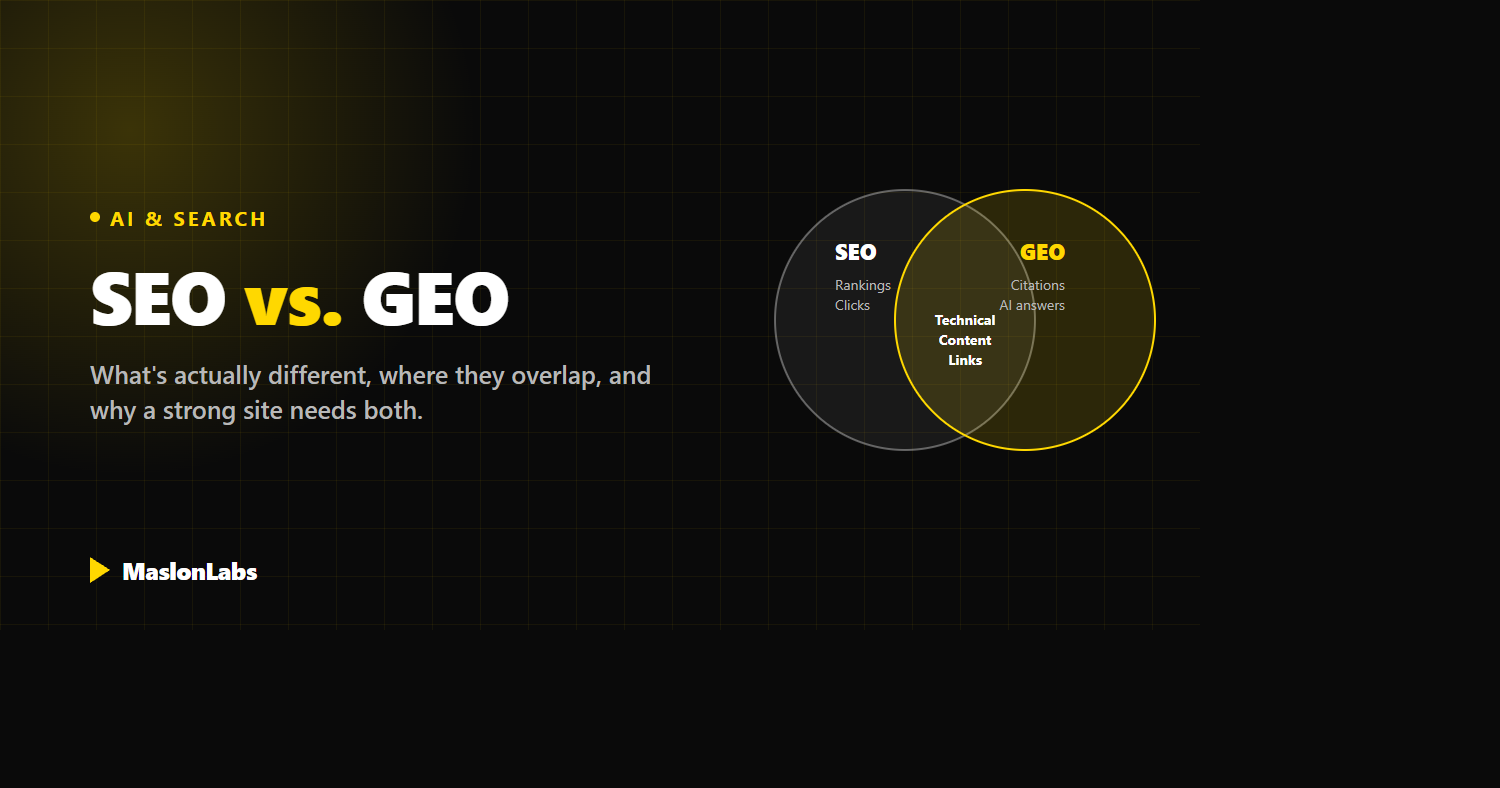
SEO optimizes for ranking on a search results page and earning clicks. GEO optimizes for being cited inside an AI-generated answer, click or not. They rely on the same technical, content, and link-building fundamentals — which is why the winning move is not choosing one, it’s doing both well.
SEO vs. GEO: Side-by-Side Comparison
| SEO | GEO | |
|---|---|---|
| Primary goal | Rank as high as possible on the results page | Get cited or quoted inside an AI-generated answer |
| Where you show up | The organic results list | AI Overviews, ChatGPT, Perplexity, Copilot answers |
| Success metric | Rankings, clicks, impressions | Citations, brand mentions, assisted (zero-click) visibility |
| Timeframe | Weeks to months, fairly predictable | Faster to test, harder to track consistently — the tooling is still maturing |
| Content requirement | Keyword-relevant, structured for skimming | Direct, factual, easy for a model to extract and summarize |
| Trust signal | Backlinks and domain authority | Backlinks plus corroboration across multiple independent sources |
| Main tools | Google Search Console, rank trackers, backlink checkers | Search Console’s Generative AI report, manual prompt testing, citation tracking |
What SEO Still Does That GEO Can’t
Classic SEO remains the more measurable, more mature discipline, and for a lot of businesses it is still where most of the revenue comes from:
- Sends an actual visitor to your site, not just an impression inside someone else’s answer
- Captures high-intent, transactional searches (“buy,” “near me,” “pricing”) where people still want to click through and compare
- Has two decades of tooling built around it — you can measure it precisely
- Works even when a query never triggers an AI answer at all, which is still most queries today
What GEO Does That SEO Can’t
GEO earns visibility in places classic ranking signals never reach:
- Shows up inside zero-click answers — visible and credible even when nobody visits your site
- Reaches people who now start their research inside ChatGPT or Perplexity instead of a search engine
- Being the cited source carries an outsized trust signal — users treat an AI citation the way they used to treat a first-page result
- Still relatively uncompetitive — most sites in most niches have not deliberately optimized for it yet
Why You Need Both (Not One or the Other)
Here’s the part most “SEO vs GEO” takes skip: the two aren’t built from different materials. A fast, well-structured, clearly written, well-linked site is exactly what both a search crawler and an AI system are looking for. We cover this in depth — along with the three-pillar framework we use with clients — in our full GEO guide. In short: optimize for one properly and you’re most of the way to the other.
Where they genuinely differ is the funnel stage. GEO tends to win the awareness stage — someone asking a broad question and getting your brand named as part of the answer. SEO tends to win the decision stage — someone ready to click, compare, and convert. Cutting either one means leaving half the funnel uncovered.
Common Mistakes When Choosing Between Them
- Treating GEO as a separate project. Building a parallel “AI strategy” instead of just doing the fundamentals well is extra work for no extra result.
- Ignoring GEO because “our traffic still comes from Google.” It does, today — the trend line is what matters, and it’s moving toward AI-mediated answers.
- Chasing exotic AI-specific markup instead of the boring fundamentals (speed, clarity, structure) that both disciplines actually reward.
- Measuring GEO with SEO metrics. A citation with no click is not a failed result — it’s a different kind of result.
For the hands-on version of the content side of this — concrete steps to make a page more citable — see How to Get Cited by AI Assistants: A 9-Step Content Checklist.
A Simple Framework for Prioritizing
If you have to choose where to spend the next hour of work:
- Local or transactional business (bookings, local services, ecommerce)? Prioritize SEO — that’s where the buyers are still clicking through.
- Informational, considered-purchase, or B2B niche where people research heavily before buying? GEO visibility pays off faster — you want to be the name that gets mentioned during that research phase.
- Either way, the technical, content, and link-building fundamentals come first. That work counts toward both.
Conclusion: It’s Not SEO vs. GEO, It’s SEO and GEO
The “vs” in the title is the hook, not the answer. SEO and GEO measure different things and win at different funnel stages, but they are built from the same work: a technically sound site, content that actually answers the question, and evidence from the rest of the internet that backs up what you say about yourself. Do that well and you show up in both.
Want a site that’s built for both from day one? That’s what our SEO & GEO service does.