
Every year someone publishes the obituary. First it was social media, then voice search, then featured snippets, and now AI. The honest answer is neither “SEO is dead” nor “nothing has changed”. Something real did change — how many people click — and something real did not: what it takes to be found, understood and chosen. This is my answer, built on documentation and measured data rather than opinion pieces.
“
SEO has been declared dead every year since I started. What dies is a tactic, never the need to be found. The tactics that died deserved to.
Quick Answer: Is SEO Dead?
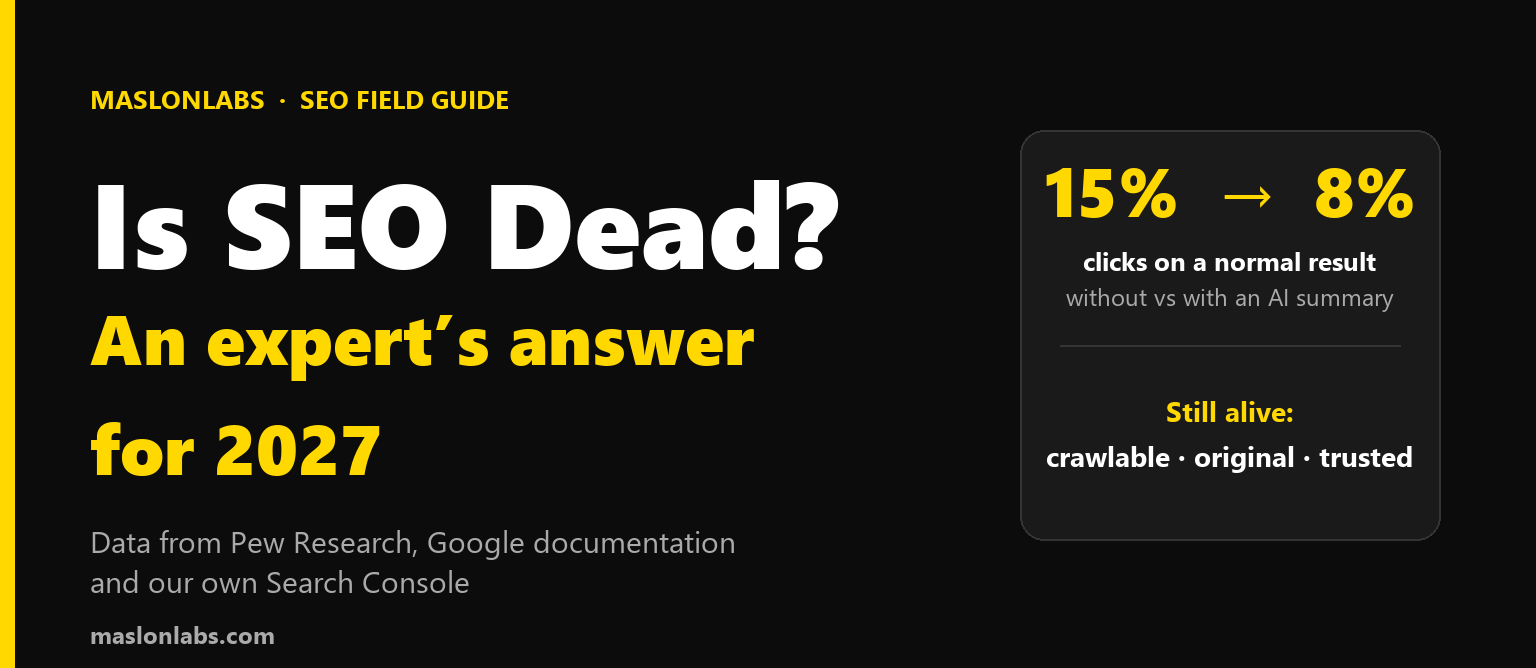
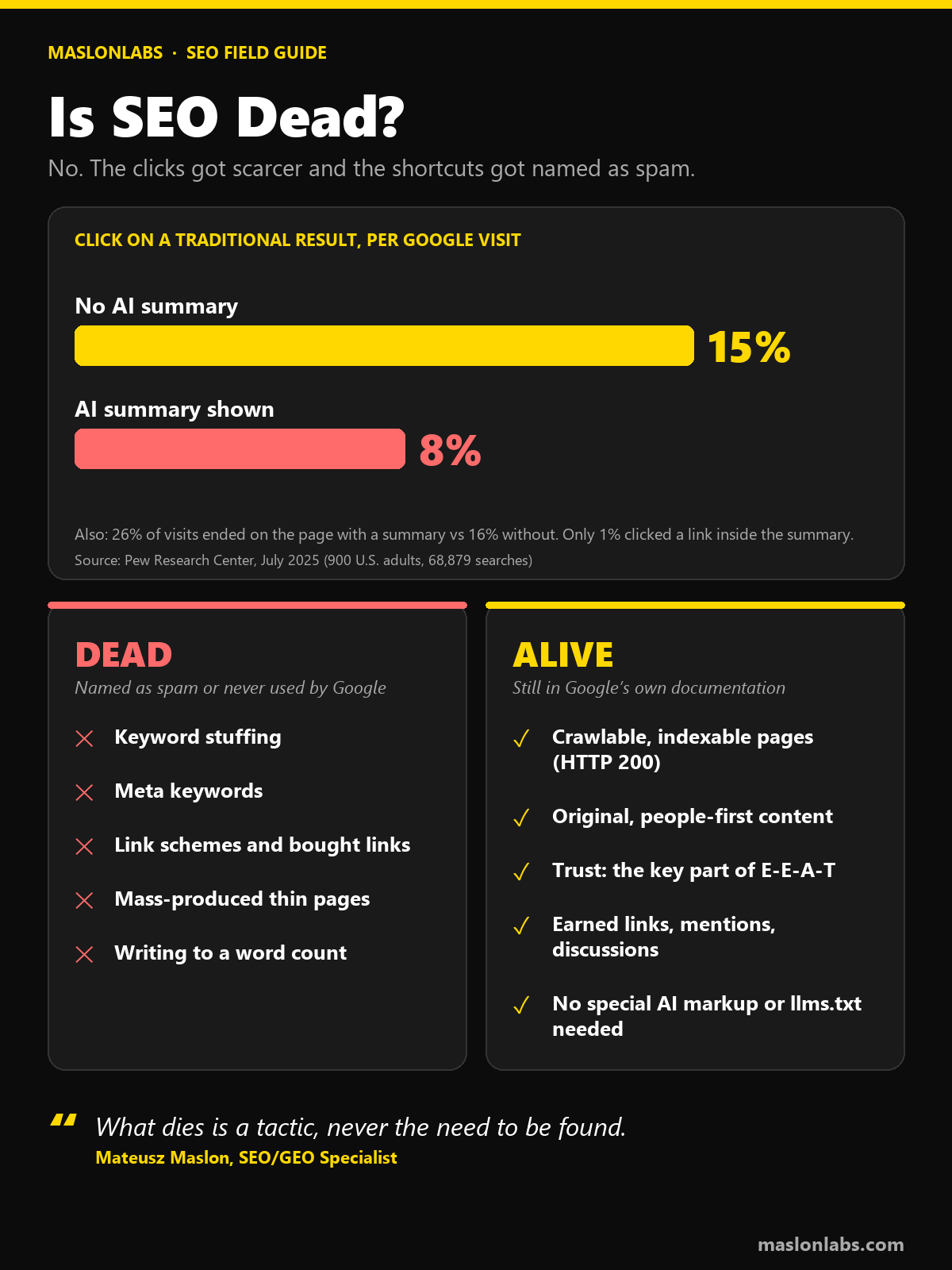
No. SEO is not dead, but the clicks are harder to win. Pew Research Center measured that people clicked a traditional result in 8% of visits when Google showed an AI summary, versus 15% when it did not. At the same time, Google’s documentation says AI Overviews and AI Mode have no additional requirements beyond being indexed and snippet-eligible. Tactics built on manipulation are dead. The foundations are not.
Where the “SEO Is Dead” Claim Comes From
It comes from a real observation: Google now answers many questions on the results page itself, through AI Overviews and AI Mode. When the answer is on the page, fewer people leave it. That is a threat to anyone whose business model was publishing generic answers and collecting the click.
That observation is correct. The conclusion drawn from it — that optimizing for search no longer matters — does not follow from the data.
What the Data Actually Shows
The most useful public dataset I know is the Pew Research Center study published in July 2025. It followed the browsing of 900 U.S. adults and analyzed 68,879 unique Google searches, of which 12,593 produced an AI summary. Browsing data was collected in March 2025 and the search results in April 2025.
| Behavior | With an AI summary | Without one |
|---|---|---|
| Visit with a click on a traditional result link | 8% | 15% |
| Visit with a click on a link inside the AI summary | 1% | n/a |
| Page where the browsing session ended | 26% | 16% |
Read this carefully. It shows that an AI summary reduces clicks to ordinary results by almost half and increases the chance a visitor stops there. It does not show that search stopped producing traffic: on pages without a summary the click rate was 15%, and the study is a snapshot of one U.S. panel from early 2025, not a measurement of your site. It also describes how people behaved, not how much revenue anyone lost.
“
The click is not dead, it is more expensive. When fewer people click, the ones who do are choosing you on purpose. That makes the page you land them on matter more, not less.
What Google Says About AI and SEO
Google’s own documentation on AI features is unusually direct: “There are no additional requirements to appear in AI Overviews or AI Mode, nor other special optimizations necessary.” A page must be indexed and eligible to be shown in Search with a snippet. You do not need new machine-readable files, AI text files or special schema.org markup, and traffic from these features is reported in your normal Search Console Performance report under the Web search type.
One detail changes the work a little: AI features may use query fan-out, running several related searches across subtopics. A page that covers its topic in depth has more ways to be selected than one that answers a single phrase. That is a content-quality point, not a new discipline. For the full breakdown see SEO Foundations in 2027.
What Actually Died
Several things people call “SEO” are dead, or never worked, and Google says so in writing:
| Tactic | What Google documents |
|---|---|
| Keyword stuffing | Listed as a spam policy |
| Meta keywords | Google Search does not use the keywords meta tag |
| Buying or swapping links at scale | Link spam is a named spam policy |
| Mass-producing pages to catch searches | Scaled content abuse is a named spam policy |
| Hitting a word count | There is no minimum or maximum content length |
| Writing for a single exact phrase | Google tells you to anticipate varied search terms |
If your SEO was one of these, then yes — it is dead, and a good riddance.
What Is Alive
- Being crawlable and indexable. Googlebot not blocked, an HTTP 200, indexable content. Without these there is no result, summary or citation of any kind.
- Original, people-first content. Google’s helpful-content guidance asks whether a page provides original information, reporting, research or analysis, and whether you are mainly summarizing what others say. Summaries are exactly what an AI summary replaces.
- Trust. Google says trust is the most important of the E-E-A-T qualities.
- Being talked about elsewhere. Links, mentions, discussions and reviews. Google does not publish a weight for these, but it recommends promoting your site where your audience gathers.
What Our Own Search Console Shows
I would rather give you a number I can check than a slogan. MaslonLabs is a small site. In Google Search Console, the 28 days to 27 October 2026 brought 542 clicks from 38,676 impressions, against 210 clicks from 8,293 impressions in the previous 28 days. That is roughly 2.6 times the clicks and 4.7 times the impressions, with an average position of 9.4 against 12.3.
Two honest caveats. The growth follows a lot of new pages published in that window, so this shows that new, useful pages get found, not that organic search is easy. And the click-through rate is only about 1.4%, which is low: we get seen far more than we get clicked, which is exactly the problem the Pew data describes.
“
When I look at our own Search Console, the story is not that search stopped working. It is that impressions are cheap and clicks are earned. Titles and the first two sentences are where that gets decided.
Who Should Worry
This part is my reading of the evidence, not a documented rule. The sites most exposed are those whose whole value was a generic answer to a generic question: if a summary can reproduce your page from other pages, there is little reason to click it. Pages that offer something a summary cannot — a tool, original data, first-hand testing, a clear expert point of view, a product the visitor can actually use — are in a better position. It is the same distinction Google draws with its question about summarizing others without adding value.
What Is Replacing SEO?
Nothing replaces it; new layers sit on top. Generative engine optimization (GEO) is about being cited in AI answers, and it relies on the same crawlable, original, trusted pages. If you want to see the difference side by side, read SEO vs. GEO and the GEO guide. Our comparison of AI visibility tools covers how to measure it.
What to Do in 2027
- Confirm your pages are indexed in Search Console. Nothing else matters if they are not.
- Audit for the dead tactics above and remove them: stuffed keywords, thin templated pages, bought links.
- Add something a summary cannot to your top pages: original data, screenshots, a tool, a named author with a point of view.
- Rewrite titles and opening sentences so that a click is a clear promise, because clicks are scarcer.
- Build external signals through mentions, discussions and reviews, not link schemes.
- Measure impressions and clicks together and track AI traffic in the Web report, as described in our Search Console guide.
Free tool: see how your site does for AI search with the GEO Audit.
Frequently Asked Questions
Is SEO still relevant in 2027?
Yes. Google states that AI Overviews and AI Mode need no special optimization beyond being indexed and snippet-eligible, so the same fundamentals still decide whether you can be found, shown and cited.
Is SEO still a thing?
Yes, but what counts as SEO has narrowed. Tactics built to manipulate rankings, such as keyword stuffing, link schemes and mass-produced pages, are named spam policies. Technical accessibility, original content and earned reputation remain.
What is replacing SEO?
Nothing replaces it. GEO and AEO are layers built on top of the same foundations, aimed at being cited in AI-generated answers rather than only ranked in a list of links.
Is content still king?
Original content is. Google asks whether a page provides original information, reporting, research or analysis. Content that only summarizes other pages is the content AI summaries replace.
Do AI Overviews reduce clicks?
In a Pew Research Center study of 900 U.S. adults, users clicked a traditional result in 8% of visits when an AI summary appeared, compared with 15% when it did not. It is a snapshot of early 2025 and does not measure any single website.
Should I stop doing SEO and only do GEO?
No. The documented requirements for appearing in Google AI features are the standard Search requirements, and most GEO practices are SEO fundamentals applied carefully. Do the foundations first.
Conclusion: SEO Did Not Die, It Got Honest
If you are deciding whether to hire help, read How to Choose an SEO Agency first.
The shortcuts are gone and the clicks cost more. What remains is the work Google has always asked for: let it in, say something original, and earn a reputation outside your own site. If that is what you were already doing, the obituary was never about you.