
Off-page SEO is the part of SEO you cannot fix by editing your own site, which is exactly why it attracts the most shortcuts. Links are bought, directories are spammed, and “authority” is treated as something you can order. This guide separates what Google documents from what the industry repeats, and lays out the legitimate ways to build a reputation outside your own pages.
“
Off-page SEO is a reputation problem, not a link problem. If nobody has a reason to mention you, no tactic will manufacture one that holds up.
Quick Answer: What Is Off-Page SEO?
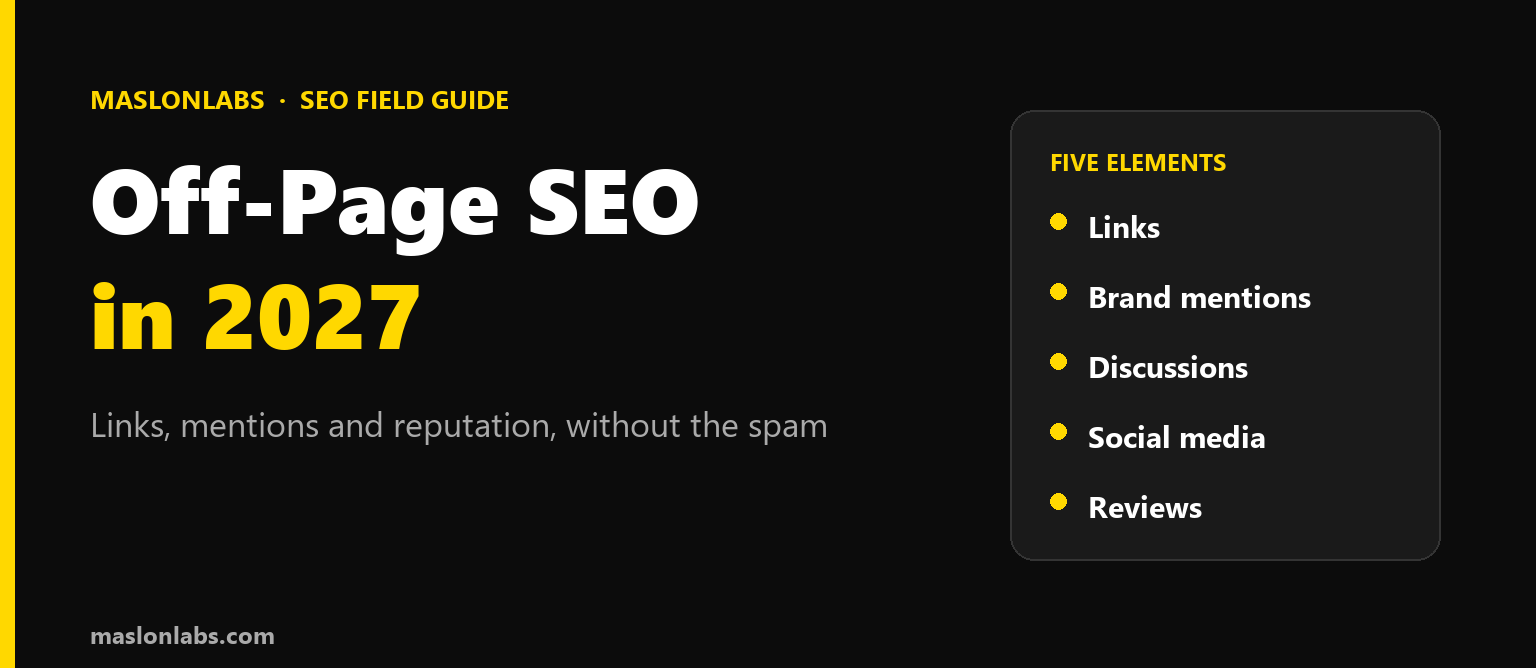
Off-page SEO is everything that happens outside your website that helps people discover and trust it: links from other sites, brand mentions, discussions and communities, social media and reviews. Google does not use the label “off-page”, but its documentation covers the same ground: it says Google mostly finds pages through links, recommends promoting your site where your audience gathers, and names link spam as a violation of its spam policies.
This article expands the third foundation from SEO Foundations in 2027. Technical and content foundations come first; without them, outside attention has nothing to land on.
What Google Says About Links
Three things from Google’s documentation shape everything below:
- Links are how Google finds pages. The SEO Starter Guide says Google mostly finds pages through links from other pages.
- Link spam is a named policy. Google defines it as creating links to or from a site primarily for the purpose of manipulating search rankings.
- Qualified paid links are allowed. Buying and selling links for advertising or sponsorship is not a violation as long as the links are qualified with
rel="nofollow"orrel="sponsored".
Google does not publish how much weight any link carries, and I will not pretend to know. What I can say from documentation is what is safe, what is risky and what is explicitly out.
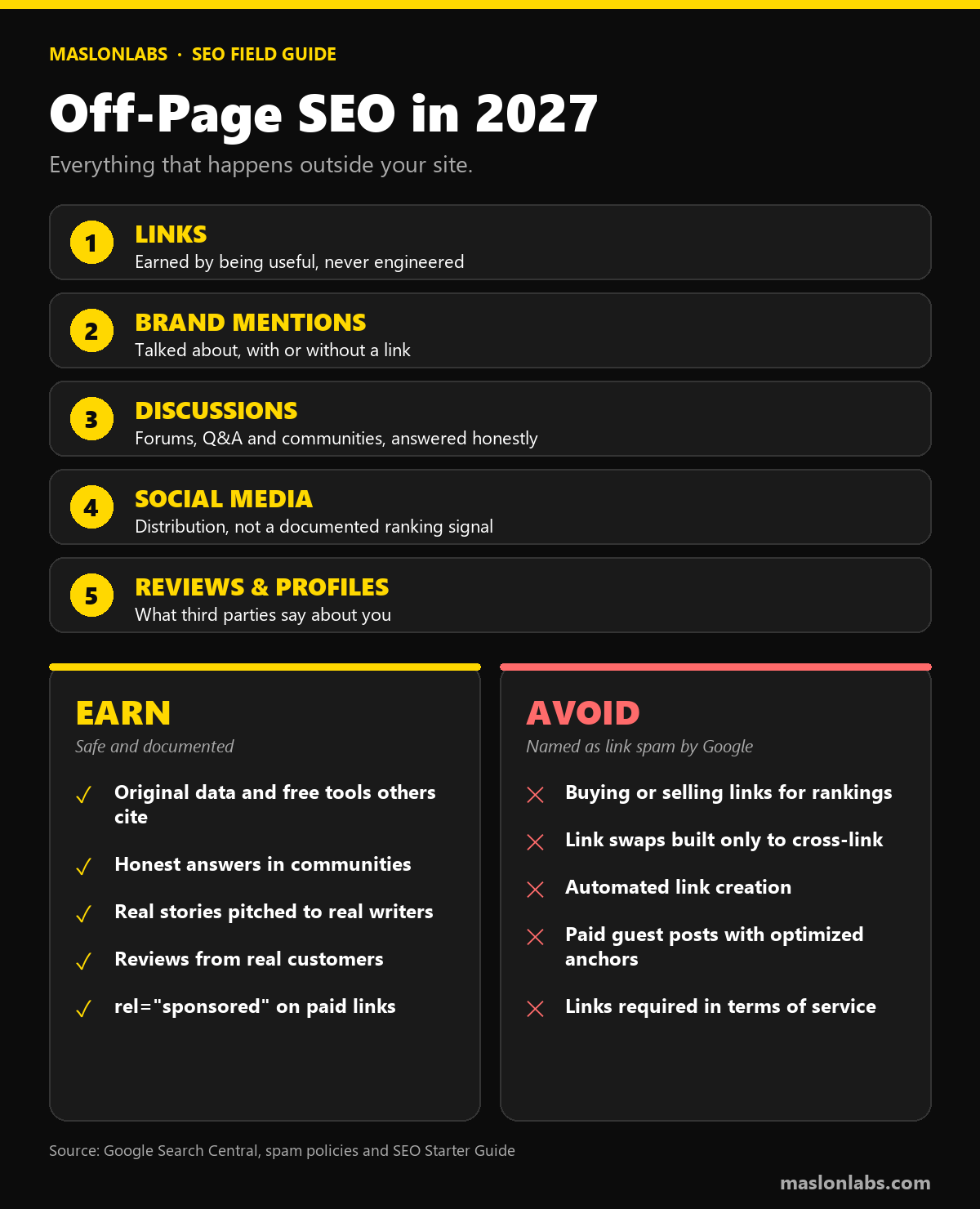
The Five Elements of Off-Page SEO
1. Links: earn them, do not engineer them
The links worth having are the ones other people place because your page is useful to their readers. In practice that means creating something worth citing: original data, a free tool, a clear explanation of something complicated. We publish free countdown tools on this site for that kind of reach; a useful tool is the sort of page others reference without being asked.
2. Brand mentions
A mention is your name appearing on another page, linked or not. Google does not document a ranking weight for unlinked mentions. In my experience, independently mentioned brands are easier to find, easier to trust and more likely to be named by AI assistants. That is an observation, not a rule.
3. Discussions and communities
Forums, Q&A sites and subreddits are where people ask what to trust. Google often shows a discussions and forums block in results, so a useful answer in a thread can reach people before your own page does. Google’s guidance is to engage in communities where your audience already is and to avoid overpromoting, which can be seen as manipulation. Answer the question first; mention your product only when it is the honest answer.
4. Social media
The Starter Guide lists social media alongside community engagement, advertising and word of mouth as ways to promote a site. Google does not document likes or shares as a ranking signal, so treat social as distribution: it is where content is seen, shared and, sometimes, linked from.
5. Reviews and profiles
Reviews, directory listings and business profiles are third-party descriptions of who you are. They carry little ranking certainty, but they are what real customers read before they decide, which is reason enough to manage them.
“
The best off-page strategy I know is boring: make something people want to reference, then tell the places where those people already are. Everything else is a shortcut with a bill attached.
What Counts as Link Spam
Google’s spam policies give concrete examples. Avoid all of these:
- Buying or selling links to affect rankings, including trading money, goods or services for links, or giving a free product in return for a write-up that includes a link.
- Link swaps and partner pages built only to cross-link (“link to me and I’ll link to you”).
- Automated programs or services that create links to your site.
- Requiring links in terms of service or a contract without letting the content owner qualify the link.
- Paid articles, guest posts or press releases on other sites with links that pass ranking credit or with optimized anchor text.
If you do run sponsored placements, Google’s answer is to mark them: rel="sponsored" for paid links (nofollow is still acceptable but sponsored is preferred), rel="ugc" for user-generated links such as comments and forum posts, and rel="nofollow" when neither fits.
Legitimate Ways to Build Off-Page Signals
- Publish something referenceable. Original numbers from your own data, a free tool, or a well-structured explanation. A page that only summarizes other pages gives nobody a reason to link to it.
- Show up in communities honestly. Answer questions in forums and Q&A threads without dropping links where they do not belong.
- Pitch real stories. Journalists and bloggers need data and expert comment; offer them yours, and do not pay for coverage that carries followed links.
- Collect reviews from real customers on the platforms your audience uses.
- Be consistent about who you are. The same name, description and links across your profiles make you easier to identify.
- Tell your own audience first. Email lists and social profiles are the cheapest distribution you have.
For the AI side of this, see how to get cited by AI assistants and the explainer on GEO.
How to Measure Off-Page SEO
Do not measure it by link count alone. I look at four things: whether new referring sites appear over time, whether branded searches grow in Search Console, whether the pages that earned mentions gain impressions, and whether AI assistants name the brand when asked a relevant question (our comparison of AI visibility tools covers how to track that). Google says changes can take from a few hours to several months to show, so judge over weeks, not days.
Frequently Asked Questions
What is off-page SEO?
Everything that happens outside your website that helps people find and trust it: links, brand mentions, discussions, social media and reviews. Google does not use the term, but its documentation covers links, promotion and link spam.
Are backlinks still important?
Google says it mostly finds pages through links, and it keeps link spam as a named spam policy. It does not publish a weight, so the safe approach is to earn links by creating something worth referencing.
Does social media affect SEO rankings?
Google does not document likes or shares as a ranking signal. Social media is useful as distribution: content that is seen and shared is more likely to be linked from elsewhere.
Is guest posting against Google’s rules?
Paid articles and guest posts with links that pass ranking credit, or with optimized anchor text, are listed as link spam. Editorial contributions where the host chooses the links and nothing is traded for them are different.
Should I use nofollow?
Use rel="sponsored" for paid links, rel="ugc" for user-generated links and rel="nofollow" when neither fits. Google says qualified paid links are not a violation.
Do brand mentions without links help?
Google does not document a ranking weight for unlinked mentions. In practice they help people and AI assistants recognize a brand, but treat that as an observed pattern, not a guarantee.
Conclusion: Build Something Worth Mentioning
Off-page SEO works when the page deserves the attention and fails when attention is bought. Get the technical and content layers right, make something people want to reference, and then go where they already are.