
For thirty years the web was built for one kind of visitor: a person looking at a screen. That is changing. AI agents now search, compare, fill in forms and even buy things on our behalf, and a new set of standards is appearing to help them do it reliably. This shift has a name: the agentic web. Here is what it means, how it works, which protocols matter and what website owners should do about it.
Quick Answer
The agentic web is the next phase of the internet, in which AI agents act on the web for people – researching, comparing, booking and buying – instead of only answering questions in a chat window. It runs on two things: agents that can operate ordinary websites like a human, and new open protocols (MCP, A2A, WebMCP, UCP, ACP, AP2, NLWeb) that let agents use websites and services directly through structured tools instead of clicking through pages.
We checked the status of every protocol and product mentioned here in November 2026. This area changes quickly, so details may have moved on.
The Agentic Web, Defined
The word “agentic” describes AI that acts, not just AI that talks. A chatbot answers your question; an agent takes a goal (“find me a hotel in Lisbon under €150 with free cancellation and book it”) and works through the steps on its own, checking back with you only for important decisions.
The agentic web is what happens when those agents become regular users of the internet. Instead of you visiting ten websites, an agent visits them for you, extracts what it needs, talks to other services and returns with a result – or completes the task outright. In November 2026 MIT Technology Review put it bluntly in a headline: “The agentic web is here”.
| Web for humans | Agentic web | |
|---|---|---|
| Main visitor | A person in a browser | An AI agent acting for a person |
| How pages are used | Read, scroll, click | Parsed, queried, called as tools |
| Discovery | Search results and links | Agent research, AI answers, protocols |
| Transactions | Human fills in forms and checkout | Agent builds the cart; human approves |
| What wins | Good design and UX | Clear data, structured tools, trust signals |
How AI Agents Use Websites Today
Agents reach websites in two very different ways, and most of today’s agentic web is a mix of both.
1. Acting through the user interface
Agents in browsers and “computer use” models read the page (its HTML and accessibility tree, often with screenshots) and then click, type and scroll like a person. This works on any website without the owner doing anything, but it is slow and fragile: a redesigned button or a pop-up can break the flow, and the agent has to guess what each element means.
2. Calling structured tools and protocols
The second route is cleaner. The website or service exposes explicit tools – “search products”, “check availability”, “create booking” – with described inputs and outputs. The agent calls the tool directly, with no guessing. This is where the new protocols come in.
The Protocols Behind the Agentic Web
2025 and 2026 brought a wave of acronyms. They are not rivals for the same job: each covers a different layer of how agents work with the web.
| Protocol | What it does | Who is behind it | Status (Nov 2026) |
|---|---|---|---|
| MCP (Model Context Protocol) | Connects AI apps and agents to tools and data sources | Created by Anthropic (Nov 2024) | Widely adopted; donated to the Linux Foundation’s Agentic AI Foundation in Dec 2025 |
| A2A (Agent2Agent) | Lets separate agents discover each other and work together | Created by Google (Apr 2025) | Open project under the Linux Foundation |
| WebMCP | Lets a web page register tools that browser agents can call | Editors from Google and Microsoft, W3C community group | Experimental, behind a flag and origin trials in Chrome and Edge |
| NLWeb | Gives a website a natural-language interface that agents can query | Microsoft (announced May 2025) | Open-source project |
| UCP (Universal Commerce Protocol) | Agents discover products, build carts and check out | Google and Shopify (Jan 2026) | Open standard, growing retail support |
| ACP (Agentic Commerce Protocol) | Programmatic checkout between agents and merchants | OpenAI and Stripe (Sep 2025) | Open standard |
| AP2 (Agent Payments Protocol) | Proves a user authorised an agent’s payment, using signed mandates | Google (Sep 2025) | Open protocol, works alongside A2A and MCP |
| llms.txt | A Markdown file pointing AI systems to a site’s key content | Proposed by Jeremy Howard (2024) | Informal proposal; mixed evidence that AI systems use it |
We cover several of these in depth: what WebMCP is and how it works, UCP and agentic commerce, and whether llms.txt actually works. If you want to see MCP in practice, see our list of the best MCP servers for SEO specialists.
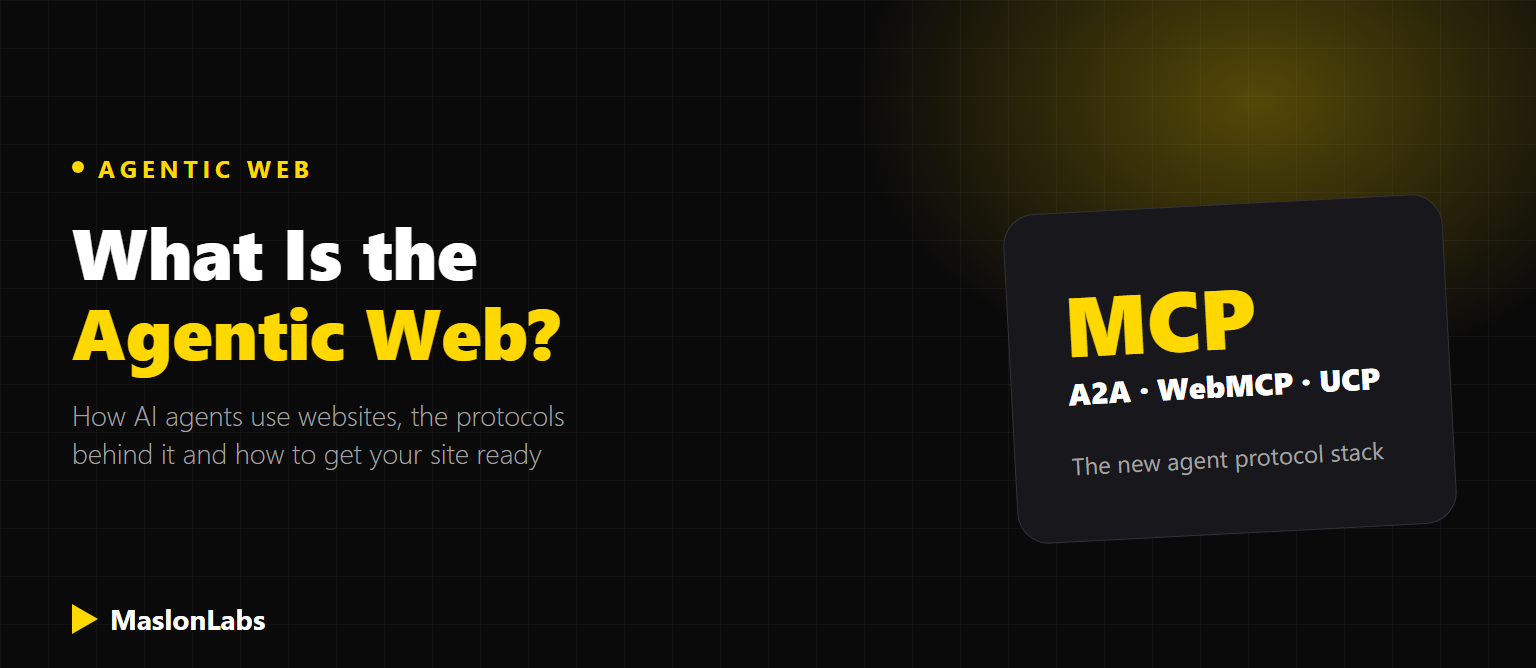
A useful mental model: MCP and WebMCP connect an agent to tools, A2A connects agents to each other, and UCP, ACP and AP2 handle buying and paying. A single shopping task in 2026 might touch all of them.
Agentic Browsers: Where People Meet the Agentic Web
For most people, the first contact with the agentic web is an agentic browser – a browser with a built-in agent that can carry out tasks across tabs. Examples include Perplexity Comet, Gemini in Chrome with auto browse, Claude in Chrome, Dia and Opera Neon. The space moves fast: OpenAI launched its ChatGPT Atlas browser in October 2025 and shut it down on August 9, 2026, moving its agent features into the ChatGPT desktop app. We compare the current options in our guide to agentic browsers.
What Changes for Websites and SEO
- Some visits become agent visits. An agent may read your pricing page, compare it with three competitors and report back – without the person ever seeing your design.
- Clarity beats persuasion. Agents extract facts: prices, specifications, availability, policies. Vague marketing copy gives them nothing to work with.
- JavaScript-heavy pages are a risk. Many AI crawlers do not render JavaScript. Content that only appears after scripts run may be invisible to them – see do AI crawlers render JavaScript?.
- Being chosen matters more than being clicked. When an agent shortlists options, the brands it picks get the business. This is closely related to generative engine optimization (GEO) and to a newer idea, agentic SEO.
- Trust and identity become a problem. Sites must tell legitimate agents acting for real users apart from scrapers and bots. Some large retailers already block outside shopping agents, and Amazon sued Perplexity over its Comet agent in November 2025.
Want to know how AI agents see your website?
Get a Free SEO & GEO Audit →How to Make Your Website Agent-Ready: A Checklist
- Let the right bots in. Check robots.txt and your firewall or CDN rules so you are not accidentally blocking AI search and agent crawlers you want (such as OAI-SearchBot, Claude-SearchBot or PerplexityBot).
- Put key content in the HTML. Prices, product details, opening hours and policies should be readable without running JavaScript.
- Use structured data. Accurate schema.org markup (Organization, Product, Offer, LocalBusiness, FAQPage, Article) helps machines read facts reliably.
- Make forms and flows machine-friendly. Clear labels, standard input types and no unnecessary steps help both agents and people.
- Publish facts agents need. Shipping costs, return windows, compatibility, prices with currency – specific, current and in one place.
- Watch the new protocols. If you sell online, follow UCP and ACP through your e-commerce platform. If you run a web app, experiment with WebMCP while it is in origin trials.
- Measure agent traffic. Check server logs for AI user agents and watch for referrals from AI assistants – our GEO self-audit checklist walks through it.
Risks and Open Questions
- Security: agents act with your logged-in sessions, so prompt injection – hidden instructions on a web page that try to hijack an agent – is a serious risk. Browser makers ask for confirmation before payments and other sensitive actions.
- Openness vs lock-in: the big question is whether agents will use open standards across the whole web or stay inside a few platforms’ walled gardens.
- Publishers’ business models: if agents read pages instead of people, ad-funded sites lose impressions. New licensing and pay-per-crawl models are emerging.
- Regulation: transparency rules such as EU AI Act Article 50 already require chatbots to disclose that users are talking to AI.
FAQ
What is the agentic web in simple terms?
It is the internet used by AI agents, not just people. Agents research, compare and complete tasks such as booking or buying on a person’s behalf, using websites and new open protocols.
What is the difference between agentic AI and the agentic web?
Agentic AI is the technology: AI systems that plan and take actions toward a goal. The agentic web is the environment that forms when those agents use websites and online services at scale.
Which protocols power the agentic web?
The main ones are MCP (agents to tools), A2A (agent to agent), WebMCP (web pages to browser agents), NLWeb (natural-language access to sites), and UCP, ACP and AP2 for shopping and payments.
Is the agentic web already here?
Partly. Agentic browsers and assistants that complete multi-step tasks are available in 2026, and commerce protocols are live with major retailers, but most websites are not yet built with agents in mind.
How do I prepare my website for AI agents?
Make sure AI crawlers can access your site, put key facts in plain HTML, use structured data, keep forms simple and clearly labelled, and follow protocols like UCP or WebMCP that fit your business.