
AI agents are changing how people use the internet — but the web was never built for them. WebMCP is Google’s answer to that problem: a new browser standard that lets websites define exactly how AI agents can interact with them, replacing fragile guesswork with structured, reliable tools. Here’s what it is, why it matters, and what it means for developers.
Key Takeaways
- WebMCP is a new web standard by Google that allows websites to expose structured tools for AI agents — making interactions faster, more reliable, and more precise than current DOM-based approaches.
- Two APIs, two use cases — the Declarative API handles simple form-based actions, while the Imperative API covers complex, dynamic JavaScript-driven workflows.
- Developers stay in control — you define exactly what agents can and cannot do on your site, similar to how
robots.txtworks for search crawlers. - It’s early, but the direction is clear — WebMCP is currently in an early preview program through Chrome for Developers, and now is the right time to start paying attention.
See what MaslonLabs has built for Android.
Explore our apps →The Web Was Built for Humans. AI Agents Are a Different Story.
When Tim Berners-Lee designed the World Wide Web, he had one type of user in mind: a human being, sitting in front of a screen, reading text, clicking links, and filling out forms. For over three decades, that assumption held.
But something has changed. AI agents — autonomous software systems that browse the web, complete tasks, and make decisions on your behalf — are becoming a real part of how people interact with the internet. And they don’t experience the web the way humans do.
For an AI agent, a website is not a visual experience. It’s a mess of HTML, JavaScript, and CSS that was never meant to be navigated programmatically. Clicking buttons, filling forms, and extracting structured information is slow, fragile, and error-prone. The web, as it was built, simply doesn’t speak AI.
That’s the problem WebMCP is designed to solve.
What Is WebMCP, Exactly?
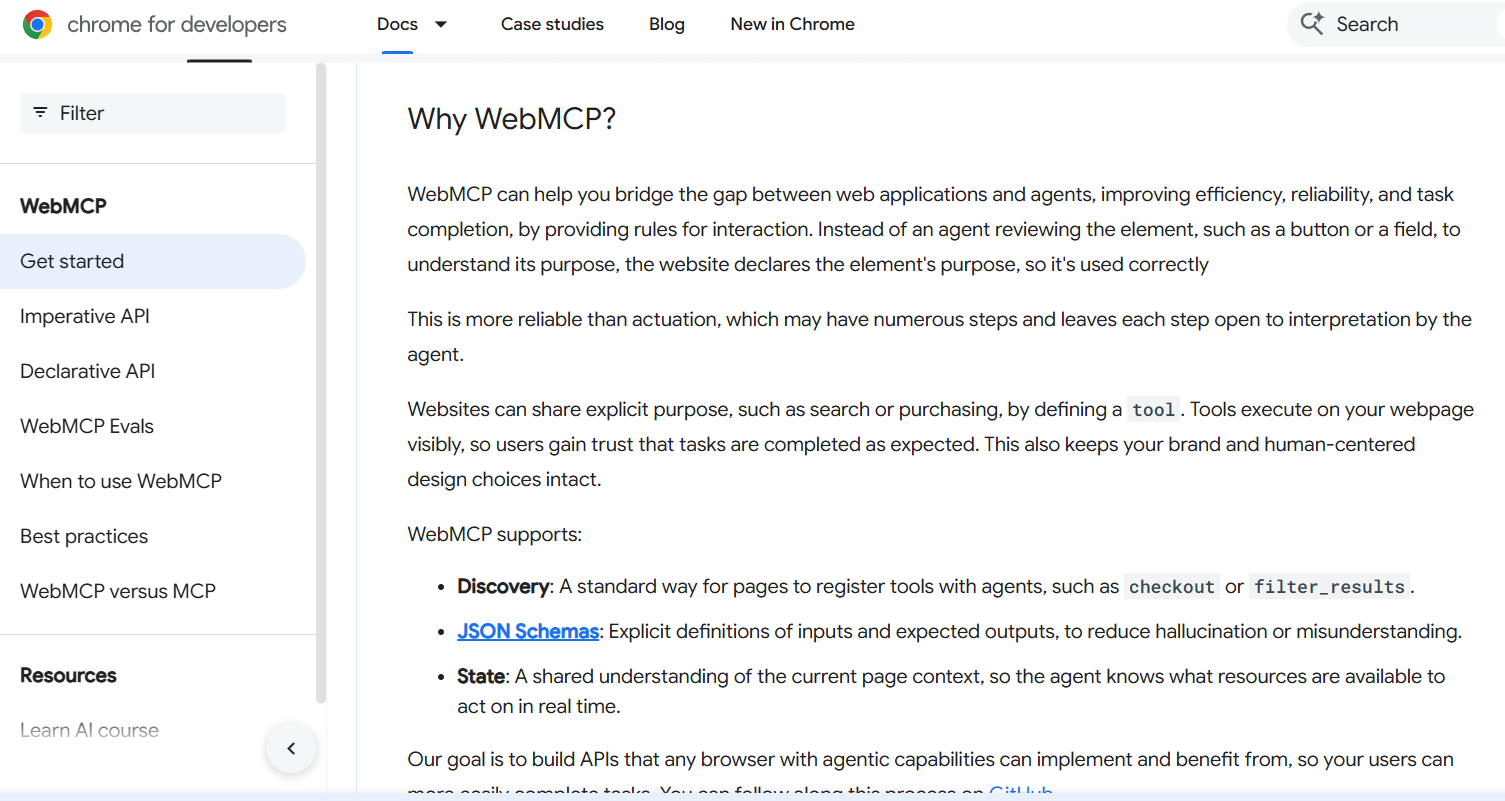
WebMCP is a new web standard proposed by Google and currently available for early preview through the Chrome for Developers program. Its goal is straightforward: give websites a way to expose structured, machine-readable tools that AI agents can use reliably, precisely, and at speed.
Think of it as adding a new layer to your website — not one that humans see, but one that AI agents can read and act on. Instead of an agent trying to figure out how to book a flight by reading and clicking through a visual interface, WebMCP lets the website say: “Here’s exactly how to search for flights, here’s how to filter results, and here’s how to complete a booking.”
The initiative is part of a broader push by Google to prepare the web for what they call the “agentic web” — an internet where AI agents perform tasks on behalf of users as a normal, everyday activity.
You can read the official announcement on the Chrome for Developers blog and explore the full documentation at developer.chrome.com/docs/ai/webmcp.
The Problem With How AI Agents Browse Today
To understand why WebMCP matters, you need to understand how AI agents currently interact with websites — and why it’s such a poor experience.
Today, most browser-based AI agents use a technique called DOM actuation: they look at the Document Object Model (the underlying structure of a web page), try to identify interactive elements like buttons, inputs, and links, and then simulate user actions to interact with them.
This approach works — sometimes. But it comes with serious limitations:
- It’s slow. An agent navigating a multi-step form has to load pages, wait for JavaScript to execute, and process visual layouts — all actions that take time and compute.
- It’s fragile. A small change to a website’s HTML structure can break an agent’s ability to interact with it entirely.
- It’s imprecise. Agents have to guess at intent. A button labeled “Continue” might mean something different on a checkout page than on a survey.
- It’s uncontrolled. From the website owner’s perspective, there’s no way to guide or constrain how an AI agent uses your site.
WebMCP addresses all of these problems by replacing guesswork with structured contracts between websites and agents.
Two Ways to Speak AI: Declarative and Imperative API
WebMCP proposes two complementary APIs, each suited to different types of interactions.
The Declarative API
The Declarative API handles standard, predictable actions — the kind that can be described using HTML forms. If your website has a search feature, a contact form, or a booking flow with well-defined inputs and outputs, the Declarative API lets you expose those actions as structured tools without writing any complex code.
For simple, form-based interactions, this is the fastest path to making your site agent-ready. An AI agent can discover available actions, understand what inputs are required, and execute them cleanly — without ever touching the visual interface.
The Imperative API
The Imperative API is for more complex, dynamic interactions that require JavaScript execution. Think multi-step wizards, real-time data lookups, or actions that depend on the current state of the application.
With the Imperative API, developers write JavaScript that defines exactly what an agent can do and how. This gives you fine-grained control over the agent experience — you decide what’s exposed, what’s protected, and what order things should happen in.
Together, these two APIs cover the full spectrum from simple form submissions to sophisticated, stateful workflows.
Curious what we’ve built with these ideas?
Explore our Android apps by MaslonLabs →Real-World Use Cases: From Flight Booking to Support Tickets
The potential applications of WebMCP go well beyond novelty. Here are some concrete examples of what becomes possible when websites speak AI:
Customer Support A user asks their AI assistant to file a support ticket for a software bug. Instead of the agent struggling to navigate a ticketing interface, the website exposes a structured tool that accepts a description, category, severity level, and supporting files. The ticket is created accurately, with all the right fields populated, in seconds.
E-Commerce A user wants to buy a specific type of running shoe in size 42, under €100, available for next-day delivery. An AI agent can search, filter, and configure options using structured tools — no need to simulate scrolling through a product grid or clicking dropdown menus.
Travel Planning a trip involves dozens of small decisions: departure city, arrival city, dates, number of passengers, seat preferences, baggage options. WebMCP lets travel websites expose each of these as a structured action, allowing an agent to handle an entire booking flow with accuracy and speed — and without the risk of misclicking.
These aren’t hypothetical scenarios. They’re the exact use cases Google highlights as the primary motivation for WebMCP.
What This Means for Web Developers
If you build websites or web applications, WebMCP is worth paying attention to now — even though it’s still in early preview.
The core idea is that you’ll be able to add WebMCP tool definitions to your existing site, declaring what agents are allowed to do and how. This is similar in spirit to how robots.txt lets you tell search engine crawlers what to index — except instead of restricting access, you’re enabling structured interaction.
The key benefits for developers:
- Control: You define exactly what agents can do on your site, rather than leaving it up to the agent to figure it out.
- Reliability: Structured tools are far less likely to break when your UI changes, since they’re defined independently of your visual design.
- Performance: Agents using WebMCP tools can complete tasks faster than those relying on DOM actuation, which means less server load and a better experience for end users.
- Discoverability: As AI agents become more capable of finding and using WebMCP tools, sites that implement the standard may gain a visibility advantage — similar to how structured data (schema.org) improved SEO.
The full technical documentation, including code examples and integration guides, is available to participants in the early preview program.
Want to see functionality-first design in action?
Browse our Android apps by MaslonLabs →What About User Control and Privacy?
Any time we talk about AI agents taking actions on behalf of users, questions of control and privacy are legitimate and important.
WebMCP is designed with this in mind. The standard doesn’t give AI agents unlimited access to your site — it gives developers the ability to define a specific, bounded set of actions that agents are permitted to take. Anything outside of those defined tools remains inaccessible through WebMCP.
From the user’s perspective, actions taken via WebMCP are still actions they’ve authorized their AI agent to perform. The agent acts on their behalf, within the permissions they’ve granted.
That said, WebMCP is still in early stages, and the details of the permission model, authentication flows, and user consent mechanisms will continue to evolve as the standard matures. This is exactly why the early preview program exists — to gather feedback from developers and refine these aspects before wider release.
Where Is WebMCP Now — and What Comes Next?
As of early 2026, WebMCP is available for prototyping to participants in Google’s Early Preview Program (EPP). This means:
- Full documentation and demos are available to registered participants
- The APIs are under active development and subject to change
- Google is actively seeking developer feedback to shape the final standard
If you want to get involved, you can sign up for the Early Preview Program through the Chrome for Developers AI documentation. Early participants get access to the latest changes, upcoming API updates, and direct channels to provide feedback to the Chrome team.
It’s worth noting that WebMCP sits alongside other emerging standards in the AI agent space — including Anthropic’s Model Context Protocol (MCP), which takes a similar approach but targets server-side integrations rather than browser-based web interactions. The two are complementary rather than competing.
The Internet Is Getting a New Layer — Are You Ready?
The web has evolved in layers. First came HTML. Then CSS. Then JavaScript. Then APIs. Each new layer didn’t replace what came before — it extended it, opening up new possibilities that weren’t possible previously.
WebMCP feels like the beginning of the next layer: a web that isn’t just human-readable, but agent-readable. A web where your website can communicate directly with the AI tools your users rely on, in a language they both understand.
This doesn’t mean the visual web goes away. It means the visual web gets a counterpart — a structured, programmable interface built for the agents that are increasingly acting on our behalf.
For developers, the opportunity is clear: get ahead of this shift, understand the standard early, and build sites that are ready for the agentic web before it becomes the expectation.
The web was built for humans. But the next version will need to speak to both.