
AI agents are starting to shop on your behalf — and in January 2026, Google and Shopify gave them a common language to do it. The Universal Commerce Protocol (UCP) is a new open standard that lets AI agents browse a retailer’s catalog, build a cart, and complete checkout without a person ever leaving the chat. Here’s what it is, how it works, and what it means for merchants and developers.
Key Takeaways
- UCP is an open standard co-developed by Google and Shopify, announced January 11, 2026 at the NRF conference, backed by Etsy, Wayfair, Target, Walmart, and 20+ partners including Visa, Mastercard, Stripe, American Express, Best Buy, and The Home Depot.
- It lets AI agents complete full commerce transactions — product discovery, cart, checkout, and post-purchase support — inside a conversational AI surface like Gemini or Google Search, without redirecting to a website.
- Merchants publish a machine-readable capabilities manifest that AI agents can read and act on automatically, instead of every platform needing a custom integration with every retailer.
- It’s open source and vendor-agnostic, available at ucp.dev, so any compliant AI agent can work with any compliant merchant.
- UCP is one of several new “agent protocols” alongside MCP, A2A, and ACP — each solving a different piece of the agentic AI puzzle.
See what MaslonLabs has built for Android.
Explore our apps →What Is the Universal Commerce Protocol?
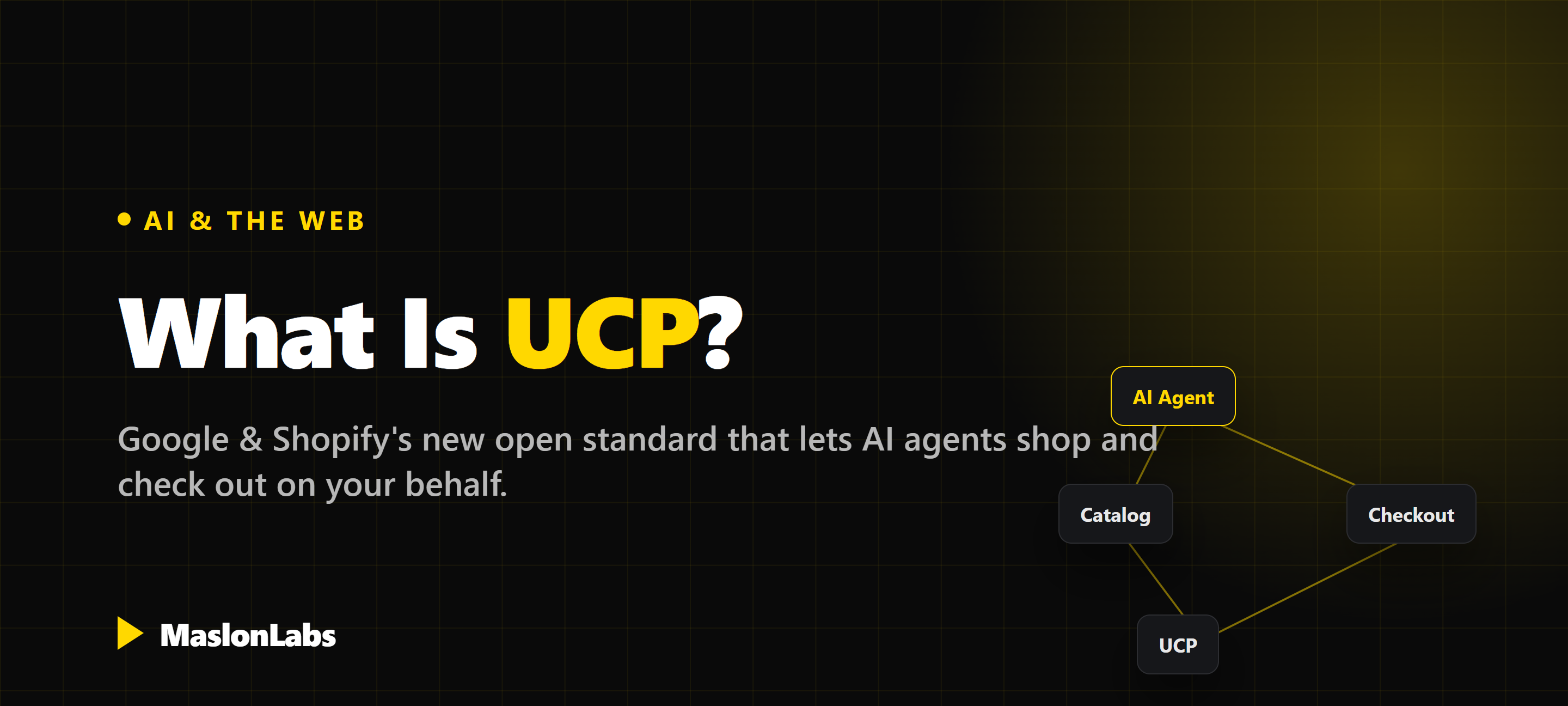
The Universal Commerce Protocol is an open standard designed to let AI agents interact with online retailers the way a human shopper would — browsing products, adding items to a cart, and completing a purchase — through a single, standardized interface rather than a custom integration for every platform.
Google announced UCP on January 11, 2026 at the National Retail Federation conference, co-developed with Shopify and endorsed at launch by major retailers including Etsy, Wayfair, Target, and Walmart, alongside payment leaders like Visa, Mastercard, Stripe, and American Express. The goal, in Google’s own framing, is to make agentic shopping “easier for everyone” by replacing a fragmented mess of one-off integrations with a single open standard.
Why Does Commerce Need a New Protocol?
Before UCP, any AI platform that wanted to let its agent complete a purchase on a given retailer’s site needed a custom, bespoke integration with that specific retailer’s checkout system. Multiply that across every AI platform (Gemini, ChatGPT, and others) and every retailer, and you get what the industry calls an “N×N” integration problem — the number of required integrations grows explosively as both sides grow.
UCP replaces that with a single, shared standard. A retailer implements UCP once, and every AI agent that speaks UCP can shop there — the same way a website only needs to follow HTML once for every browser to render it, instead of building a custom version for each one.
How UCP Actually Works
At a high level, a UCP transaction moves through a few consistent phases:
- Discovery — a merchant publishes a machine-readable profile describing what it supports (catalog access, checkout, loyalty programs). An AI agent fetches this profile to understand what it can do at that store in milliseconds.
- Capability negotiation — the agent and the merchant’s system compare what each of them supports, and agree on the exact set of features available for that specific transaction.
- Catalog and cart — the agent retrieves real-time product details (variants, pricing, inventory) and can add one or multiple items to a cart in a single step, the way a person would shop across a site.
- Secure checkout — rather than handling raw payment details directly, the transaction uses tokenized credentials through a trusted payment provider, so sensitive card data never has to pass through the AI platform or sit exposed on the merchant’s side.
- Post-purchase tracking — order status and fulfillment updates flow back through the same standardized channel, so the agent (and the user) can track a real order rather than a one-off chat message.
The protocol is also designed to be transport-agnostic — able to run over plain REST APIs, or alongside other agent standards like MCP and A2A — rather than locking merchants into one specific technical stack.
Who’s Behind UCP?
UCP is co-developed by Google and Shopify as an open, community-governed standard rather than a closed, single-vendor system. At launch, it had backing from major retailers (Etsy, Wayfair, Target, Walmart) and more than 20 partners spanning payments (Visa, Mastercard, Stripe, American Express) and retail (Best Buy, The Home Depot). Google has also said it is simplifying onboarding through Merchant Center, specifically to make UCP adoption realistic for smaller retailers, not just large enterprise players.
UCP vs. MCP vs. A2A vs. ACP: How the New Protocols Fit Together
2026 has brought a wave of new acronyms for how AI agents connect to the outside world, and it is easy to conflate them. They are not competitors solving the same problem — each covers a different layer:
- MCP (Model Context Protocol), from Anthropic, is a general-purpose standard for connecting an AI model to external tools and data sources. We covered it in detail in our WebMCP article — a related, browser-focused standard built on similar ideas.
- A2A (Agent-to-Agent), from Google, standardizes how separate AI agents communicate and coordinate with each other, rather than how an agent talks to a single tool.
- ACP (Agentic Commerce Protocol) is a separate commerce-focused standard associated with OpenAI and Stripe, addressing a similar problem to UCP from a different corner of the industry.
- UCP (Universal Commerce Protocol), covered in this article, is specifically for end-to-end commerce transactions: catalog, cart, checkout, and order tracking.
In practice, a full 2026 AI agent stack is likely to use several of these together: MCP or A2A to give an agent access to tools and other agents, and UCP or ACP specifically when that agent needs to complete a real purchase.
Curious what we’ve built with these ideas?
Explore our Android apps by MaslonLabs →What This Means for Merchants and Developers
If you run an online store, UCP is worth watching even if you are not ready to implement it today. As adoption grows through 2026, agentic checkout is likely to become a real, measurable channel alongside your website and app — and getting your product catalog and checkout flow UCP-ready early is a genuine competitive advantage, not just a technical exercise.
If you build software rather than sell products directly, the more durable lesson is the pattern itself: AI agents increasingly expect a structured, machine-readable way to interact with a service, instead of scraping a UI built for humans. That is true for e-commerce checkout today, and it is very likely to extend to other categories of software — including mobile apps — as agentic AI keeps expanding.
Where Is UCP Now, and What Comes Next?
As of mid-2026, UCP is live and actively expanding rather than a future proposal. Google has continued shipping capability updates (cart management, catalog access, identity and loyalty linking) since the January launch, and partners including Commerce Inc and Salesforce have announced support, with more expected. It is still early — most shoppers are not checking out through an AI agent yet — but the direction is clear and moving quickly.
Want to see functionality-first design in action?
Browse our Android apps by MaslonLabs →Frequently Asked Questions
What does UCP stand for?
UCP stands for Universal Commerce Protocol — an open standard that lets AI agents complete shopping and checkout transactions on a person’s behalf.
Who created UCP?
Google and Shopify co-developed UCP as an open standard, announced on January 11, 2026 at the NRF conference. It launched with support from Etsy, Wayfair, Target, and Walmart, plus payment partners including Visa, Mastercard, Stripe, and American Express.
Is UCP the same as MCP?
No. MCP (Model Context Protocol) is Anthropic’s standard for connecting AI models to tools and data sources in general. UCP is specifically built for commerce transactions — catalog access, cart, and checkout. The two are complementary and can be used together in the same AI agent stack.
Does UCP replace a retailer’s website?
No. UCP adds a new, AI-agent-facing sales channel alongside a retailer’s existing website, similar to how a mobile app does not replace a website but adds another way for customers to buy.
Is UCP open source?
Yes. The protocol specification is open source, available at ucp.dev, and designed to be vendor-agnostic so any compliant AI agent can work with any compliant merchant.
How does UCP handle payment security?
Payment details are exchanged as tokens through trusted credential providers rather than raw card data ever reaching the merchant directly — conceptually similar to how Apple Pay or Google Pay already tokenize card details today.
The Web Is Getting a Checkout Counter for AI
We wrote in our WebMCP article that the web is gaining a new layer — one built to be read by agents, not just people. UCP is that same shift showing up at the checkout counter.
For most of the web’s history, buying something online meant a person clicking through pages, filling in a card number, and hitting confirm. UCP is a bet that a meaningful share of that flow moves into a conversation instead — and that retailers, platforms, and developers who understand the new protocol early will be the ones ready when it does.