
User preferences are evolving at a breakneck pace. Today, people increasingly gravitate toward generative AI experiences to find information quickly and intuitively. To meet these changing expectations, Google is fundamentally upgrading its search engine.
For website owners, this transformation is not a threat—it is a massive opportunity. Succeeding in generative AI features like AI Overviews and AI Mode allows you to reach highly engaged users who are more inclined to spend time with your content, subscribe, or make a purchase.
Based on official best practices from Google Search, this comprehensive guide will show you exactly how to optimize your website for the future of AI-driven search.
See what MaslonLabs has built for Android.
Explore our apps →How Does Generative AI Work in Google Search?
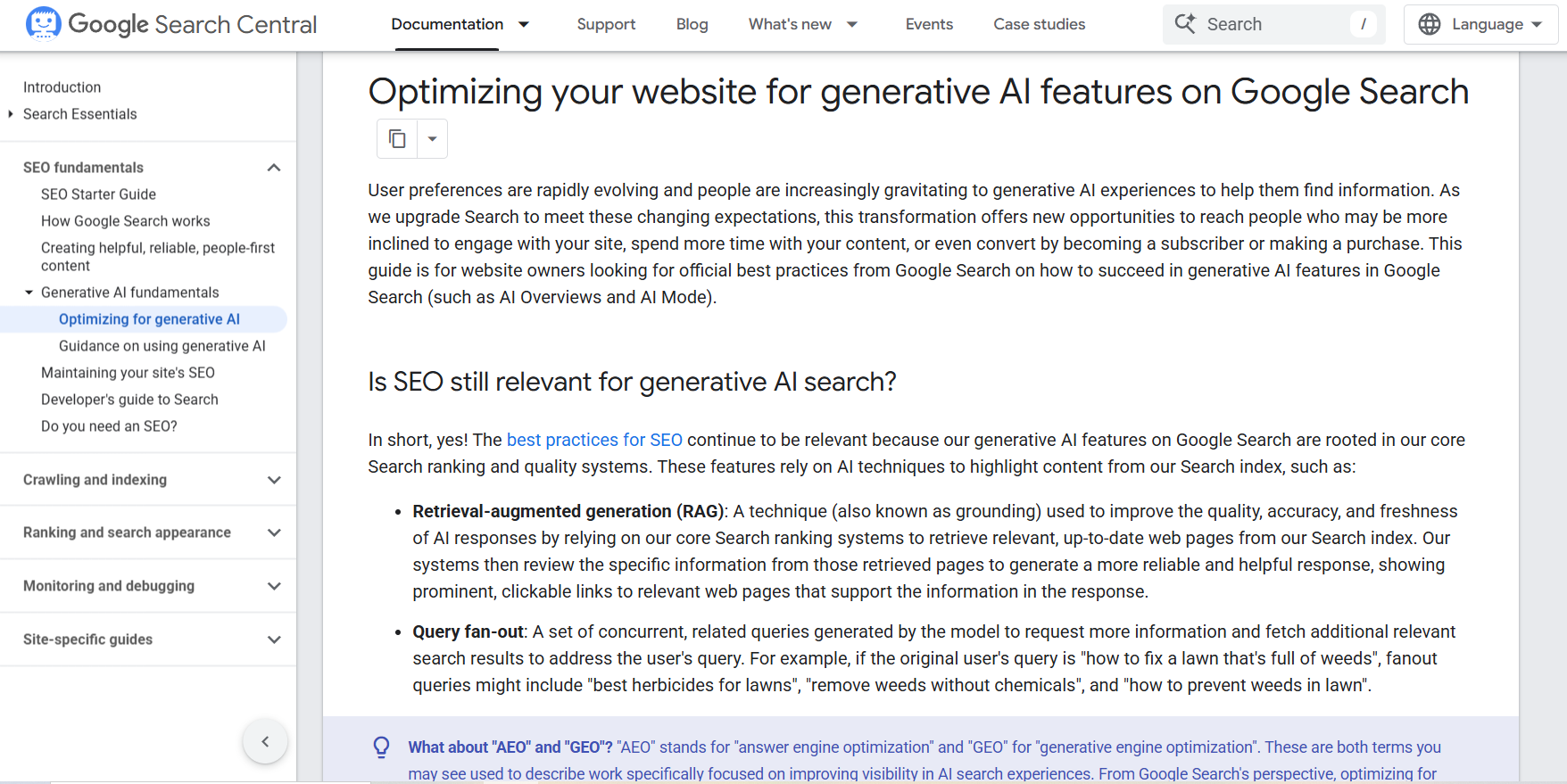
To optimize your website effectively, you first need to understand the mechanics happening under the hood. Google’s AI features do not operate in a vacuum; they are deeply rooted in core Search ranking and quality systems.
What Is Retrieval-Augmented Generation (RAG) and How Does Grounding Work?
Google uses a powerful technique called Retrieval-Augmented Generation (RAG), also known as grounding. Instead of letting an AI model generate answers based solely on its training data (which can lead to outdated information or “hallucinations”), RAG forces the AI to anchor its responses in reality.
When a user asks a question, Google’s core ranking systems retrieve relevant, up-to-date web pages from the traditional Search index. The AI then reviews the specific information from those retrieved pages to generate a reliable, helpful response. Most importantly, it displays prominent, clickable links back to the source web pages that support the information. If your site isn’t indexed, the AI cannot use it as a ground truth.
What Is Query Fan-Out and How Does It Affect Search Behavior?
When a user submits a query, Google’s AI models often generate a set of concurrent, related queries behind the scenes. This process is called Query Fan-Out.
The model uses these fanned-out queries to request more information and fetch additional relevant search results to fully address the user’s intent. For example, if a user searches for “how to fix a lawn that’s full of weeds”, the system might simultaneously run queries like:
- “best herbicides for lawns”
- “remove weeds without chemicals”
- “how to prevent weeds in lawn”
By understanding this, you can structure your content to address the broader topical ecosystem rather than just a single, narrow keyword phrase.
Are SEO, GEO, and AEO Mutually Exclusive?
As artificial intelligence dominates tech headlines, the marketing industry has been flooded with new acronyms, leading to confusion about the future of digital marketing.
Is Traditional SEO Still Relevant for Generative AI Search?
In short: yes, absolutely. The foundational best practices of SEO continue to be completely relevant. Because generative AI features rely on Google’s core Search ranking and quality systems to pull data, you cannot have good AI visibility without strong traditional SEO.
What is Google’s Perspective on “Generative Engine Optimization” (GEO) and “Answer Engine Optimization” (AEO)?
You have likely seen terms like AEO (Answer Engine Optimization) or GEO (Generative Engine Optimization) tossed around by agencies and gurus. From Google Search’s perspective, optimizing for generative AI search is simply optimizing for the overall search experience. In other words, GEO and AEO are just different facets of modern, holistic SEO. There is no secret, separate system to optimize for.
How to Create Content That Google’s AI Wants to Source?
Creating unique, compelling, and useful content will influence your website’s presence in generative AI search more than any technical trick or hack. Google’s systems are trained to find and highlight exceptional content.
What Is “Non-Commodity Content” and Why Is It Crucial for AI Search?
Google makes a strict distinction between “commodity” and “non-commodity” content:
- Commodity Content: This is generic, common-knowledge information that anyone could write or that an AI model could easily generate on its own (e.g., “7 Tips for First-Time Homebuyers” covering basic, recycled facts). It adds little unique insight.
- Non-Commodity Content: This is expert-led, experience-driven content that goes beyond the ordinary. It offers fresh angles, deep insights, or first-hand case studies (e.g., “Why We Waived the Inspection & Saved Money: A Look Inside the Sewer Line”).
Google’s AI systems actively look for non-commodity content because it provides real value that cannot be simulated by an LLM.
How Do You Provide a Unique Point of View to Stand Out from AI Summaries?
Because AI overviews analyze multiple sources at once, your content needs a unique viewpoint to stand out. Share your personal, first-hand reviews, data-driven experiments, or specific industry insights. Do not just recycle what others on the internet have already said. Bring your in-depth experience to the table.
How Should You Organize Content to Best Serve Human Readers?
Always write for human beings, not for AI bots. People—and subsequently AI scrapers—appreciate content that is well-written and easy to follow. Organize your web pages cleanly using paragraphs, distinct sections, and logical headings (H2, H3) that provide a clear structure to navigate the topic.
Why Are High-Quality Images and Videos More Important Than Ever in AI Search?
Generative AI search features frequently pull in relevant images and videos directly into AI responses. This opens up massive opportunities for your website to appear beyond traditional blue web page links. Ensure you support your text with high-quality, relevant media, and strictly follow established Image and Video SEO best practices.
Should You Target Every Single Variation of Fan-Out Queries?
It might be tempting to create dozens of separate, thin pages to target every possible variation of how people might search (or every fanned-out query). Do not do this.
Creating mass variations of content primarily to manipulate rankings violates Google’s scaled content abuse spam policy. Google’s AI systems are advanced enough to understand the deeper relevance of your pages, even if there is no exact keyword match. Focus on comprehensive, highly satisfying pages instead of keyword-stuffed clusters.
What Are Google’s Policies Regarding the Use of Generative AI Tools for Content Creation?
You can use generative AI tools to assist you in brainstorming, outlining, or drafting content. However, the final output must strictly meet the standards of Google’s Search Essentials and spam policies. If your AI-assisted work reads like generic commodity content, it will not succeed.
What Is the Single Core Principle for Long-Term Content Success?
When in doubt, simplify your approach by asking yourself one question:
“Is this content that my visitors would find satisfying, helpful, and reliable?”
If the answer is yes, you are on the right track. Google’s systems are engineered specifically to connect human users with satisfying, people-first information.
Curious what we’ve built with these ideas?
Explore our Android apps by MaslonLabs →How to Build and Maintain a Clear Technical Structure for AI Discovery?
The way Google Search crawls, finds, and processes your pages remains the core infrastructure for how its AI systems access your data. Technical clarity ensures your site is ready for discovery.
What Are the Core Google Search Technical and Snippet Requirements?
To be eligible to appear in generative AI features, your page must first be successfully indexed and eligible to show a standard snippet in regular Google Search. It must fulfill all core technical requirements. Keep in mind that meeting these requirements makes you eligible, but indexing and serving are never guaranteed.
How Do Crawling Best Practices and Crawl Budget Optimization Impact AI Search?
Google Search generative AI models use publicly accessible, crawlable content to learn patterns and provide grounded responses. If your site blocks Googlebot or has massive crawl errors, the AI will never see your content. For very large or frequently updated websites, regularly optimize your crawl budget to ensure fresh content is indexed immediately.
Do You Need Perfect Code, or Does Semantic HTML Suffice for Accessibility and Readability?
You do not need technically flawless, 100% valid HTML code—the modern web is messy, and Google’s parsers are highly forgiving. However, using clean, semantic HTML tags (like <article>, <header>, 📂, etc.) is highly recommended. It helps both AI crawlers and human screen readers navigate your content easily.
What Are the JavaScript SEO Best Practices You Must Follow?
Google can process content rendered within JavaScript, provided it is not blocked by your robots.txt. However, optimizing JavaScript frameworks (like React or Angular) is inherently complex. Ensure your critical content is rendered server-side or easily indexable to avoid being skipped by the crawler.
How Does Page Experience and Latency Reduction Impact AI Indexing?
Providing a seamless page experience remains a ranking factor. Your site must display perfectly across all devices, reduce latency (load quickly), and make it incredibly easy for users to distinguish main content from ads or secondary sidebar elements.
Why and How Should You Reduce Duplicate Content?
Duplicate content confuses search engines, degrades user experience, and forces crawlers to waste valuable resources on identical URLs. Clean up your canonical tags, redirect duplicate URLs, and minimize internal content redundancy.
How Can Google Search Console Help You Diagnose Technical AI Issues Early?
Verify your site in Google Search Console. It remains the single best tool to discover crawl errors, monitor indexing status, and quickly diagnose potential technical roadblocks that could prevent you from appearing in AI features.
How to Optimize Local Business and Ecommerce Details for AI Responses?
Generative AI responses frequently display interactive product listings, live pricing, and hyper-local business recommendations.
How Can Google Merchant Center Feeds and Google Business Profiles Boost AI Visibility?
If you run an e-commerce shop or a local business, you must actively feed data into Google’s ecosystem. Utilizing Google Merchant Center feeds and maintaining an active Google Business Profile feeds structured, real-time data straight into the AI’s retrieval systems. This ensures your products and local services show up vividly in conversational search.
What Is the “Business Agent” Conversational Experience on Google Search?
Google is introducing deeper merchant experiences, such as Business Agent. This is an interactive, conversational feature on Google Search that allows prospective customers to chat directly with your brand, ask product questions, and interact with your business autonomously. Stay ahead of the curve by exploring these features in your Google dashboard.
Want to see functionality-first design in action?
Browse our Android apps by MaslonLabs →AI Search Mythbusting: What Can You Safely Ignore?
As AI search continues to evolve, the internet has become flooded with unverified theories, “hacks,” and misconceptions. Google has explicitly outlined several prominent tactics that you can safely ignore.
Do You Need llms.txt Files or Other “Special” AI Markups?
No. You do not need to create machine-readable files like llms.txt, specific AI text files, or markdown-only versions of your site to appear in generative AI search. While Google can crawl these files, it does not treat them with any special favoritism. Standard HTML is perfectly fine.
Is “Chunking” Content into Tiny Pieces Required for AI Understanding?
No. There is absolutely no requirement to break or “chunk” your articles into tiny, bite-sized sections for an AI to digest it. Google’s advanced semantic systems easily comprehend the nuance of multiple complex topics within a single page and can extract the exact sentence a user needs. Write natural, comprehensively long or short pages based purely on your audience’s needs.
Do You Need to Rewrite Content or Force “Long-Tail” Keywords Just for AI Systems?
No. You do not need to adjust your prose or unnaturally insert exact long-tail keywords to cater to an AI. Modern AI systems understand synonyms, contextual intent, and the generalized meaning of a query. Focus on clear, natural language.
Does Seeking Inauthentic Mentions on Blogs and Forums Help AI Rankings?
No. While Google AI can summarize what is being said about a brand across the web (including forums and blogs), fabricating fake reviews or seeking inauthentic “mentions” will backfire. Core ranking systems filter for high-quality authority, and spam-prevention systems actively block manipulated content.
Should You Overfocus on Structured Data (Schema.org) Specifically for AI?
No. There is no “special” schema.org markup required for generative AI search. You should absolutely keep using structured data as part of your traditional SEO strategy to win rich snippets, but do not look for a hidden “AI schema code”—it does not exist.
Quick Reference: AI Search Optimization Matrix
To help you prioritize your tasks, here is a quick summary of what genuinely impacts your visibility in Google’s AI Search versus what you can safely ignore:
| What to FOCUS On (High Impact) | What to IGNORE (No Impact / Myth) |
|---|---|
| Non-Commodity Content: Unique insights, first-hand experiences, and expert opinions. | AI-Targeted Rewriting: Forcing exact long-tail keywords or phrasing just for the AI. |
| Traditional SEO Foundations: Flawless indexing, clean crawl budget, and solid ranking. | Special AI Markups: Creating llms.txt files or other machine-specific text files. |
| Rich Media Integration: High-quality, relevant images and videos optimized for search. | Content “Chunking”: Breaking your articles into tiny fragments for the AI to “understand”. |
| Google Eco-Systems: Active Merchant Center feeds and updated Google Business Profiles. | Inauthentic Mentions: Spatially farming fake reviews or brand mentions on forums. |
| Flawless Page Experience: Low latency, mobile responsiveness, and clean semantic HTML. | Special AI Schema: Searching for or overfocusing on non-existent “AI structured data”. |
How to Prepare Your Site for Future “Agentic Experiences”?
Looking ahead, the web is transitioning toward autonomous AI agents—systems that can perform tasks on behalf of a user, such as automatically booking a hotel reservation or comparing deeply specific product specifications.
What Are Autonomous AI Agents (Browser Agents) and How Do They Interact with Your Site?
Browser agents are AI systems that will actively visit your website to gather data required to complete complex actions. Instead of just reading text, these advanced agents may analyze visual renderings (taking screenshots), inspect the underlying DOM structure, and interpret the site’s accessibility tree to interact with buttons and forms like a real human would.
What Best Practices Make a Website Friendly for Current Browser Agents?
To ensure your site is ready for AI agents, focus on clean layouts, accessible forms, and logical navigation. If your site relies heavily on convoluted pop-ups, broken scripts, or hidden buttons, an autonomous agent will fail to navigate it, causing the user to take their business elsewhere.
What Is the Universal Commerce Protocol (UCP) and Why Does It Matter for E-commerce?
New open standards like the Universal Commerce Protocol (UCP) are emerging. These protocols allow AI Search agents to communicate seamlessly with e-commerce platforms, enabling them to verify stock, process details, and execute actions programmatically. Keep an eye on UCP developments if you operate in the e-commerce space.
Conclusion: What Are Your Key Takeaways and Next Steps for AI Search Success?
The age of AI search does not require you to reinvent the wheel. In fact, many websites thrive in generative AI experiences without any overt SEO manipulation at all. To secure your future visibility, focus on these core next steps:
- Double down on foundational SEO: Maintain a pristine technical structure, optimize your crawl health, and fix page experience latencies.
- Exterminate commodity content: Stop publishing generic, low-effort summaries. Focus heavily on creating unique, expert-led, non-commodity content rooted in real-world experience.
- Ignore the hacks: Do not waste your time “chunking” content, chasing inauthentic forum mentions, or building custom
llms.txtfiles. - Prepare for agents: Keep your technical foundation robust, clear, and accessible so both human screen-readers and future autonomous AI agents can browse your services seamlessly.