
Building an Android app and getting it onto the Play Store is only half the job — the other half is deciding how it actually makes money, and that decision is where a lot of apps quietly fail. There is no single right answer here. The right model depends entirely on what the app does and who uses it, and most successful apps in 2026 combine more than one method rather than betting on just one.
Building an app and not sure how it should make money?
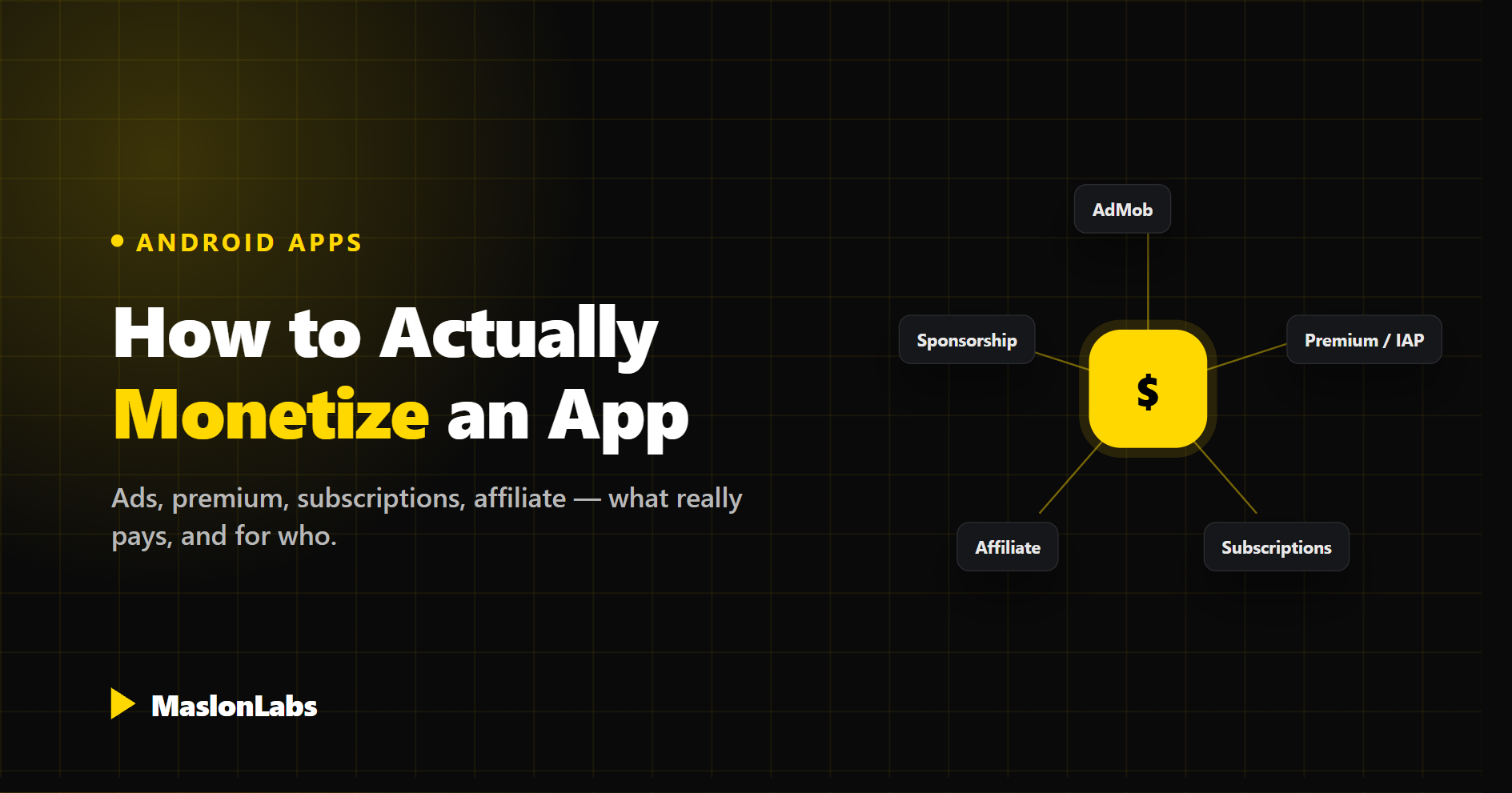
Get a Free Consultation →The Five Real Ways to Monetize an Android App
Ads (AdMob)
Premium / IAP
Subscriptions
Affiliate
Sponsorship
1. Ads (AdMob and Similar Networks)
Google’s AdMob is still the default starting point for most free apps, mainly because it is the fastest to set up and works with almost any app, regardless of what it does. It pays through several ad formats — banner, interstitial, native, and rewarded — and rewarded ads in particular (“watch 15 seconds to unlock X”) tend to convert well because the user is opting in rather than being interrupted.
Ads work best for apps with genuinely high usage frequency and low natural willingness to pay — utilities, simple tools, and casual games are the classic fit. They work poorly for apps people use rarely or for a few seconds at a time, since there just aren’t enough ad impressions to add up to real revenue.
2. Premium Unlock / One-Time In-App Purchases
A one-time purchase that removes ads or unlocks extra features is simple for users to understand and simple to build. It suits apps where the value is delivered once, upfront — unlocking every difficulty level in a game, or removing ads permanently for someone who plans to use the app regularly.
The tradeoff is that a one-time purchase caps how much a single user can ever be worth to you, no matter how much they love the app. It also depends on Google Play Billing for the transaction itself (or an approved alternative), which brings its own fee structure — see the note on 2026’s fee changes below.
3. Subscriptions
A recurring monthly or annual payment for ongoing access tends to produce the highest long-term revenue per user of any model, which is why it dominates in productivity, fitness, education, and content-heavy apps. It only works, though, if the app keeps delivering new value over time — a subscription for something used once and forgotten just produces refund requests and bad reviews.
2–5%
Typical free-to-paid conversion rate for freemium apps in 2026 industry benchmarks — category matters far more than the average, and a rate that’s excellent for a casual game can be mediocre for a productivity app.
4. Affiliate Marketing
This one is underused outside of content-heavy apps, but it fits more categories than people assume. If your app naturally recommends products, services, or other apps — a shopping list app linking to where to buy items, a fitness app linking to gear, a parenting app linking to products it mentions — an affiliate link earns a commission on anything the user goes on to buy, at no cost to them.
It rarely works as a primary model on its own, but it is close to free to add on top of another model, since it doesn’t require building payment infrastructure into the app at all.
5. Sponsorship and Data Partnerships
For apps with a genuinely large, engaged audience, direct sponsorship (a brand paying for placement or a mention) can outperform ad networks on a per-impression basis. This one only becomes realistic at real scale, and it’s worth being direct about the other side of this category: selling anonymized usage data to third parties is technically an option some apps use, but it carries real privacy and trust costs, and Google Play’s own developer policies restrict what can be shared and how it must be disclosed. We’d treat this one with real caution, not as a default.
The Hybrid Model Most Apps Actually Use
In practice, the highest-performing apps rarely rely on one method. A common, sensible pattern: ads for the free tier, an optional one-time or subscription premium unlock to remove them and add extra features, and maybe an affiliate link somewhere it fits naturally. That’s roughly how several of our own apps are set up — free with ads and a light IAP or premium tier, rather than one single aggressive model.
Choosing a Model for Your App
| If Your App Is… | Consider | Because |
|---|---|---|
| A simple utility or tool used briefly, often | Ads + optional one-time premium unlock | High usage frequency makes ad impressions add up; low willingness to pay for a small tool |
| Used daily and delivers ongoing value | Subscription, maybe with a free tier | Recurring value justifies a recurring payment; this is where LTV is highest |
| A game with clear progression | Ads (rewarded) + one-time IAP | Rewarded ads fit naturally into progression; IAP suits unlocking content once |
| Content or recommendation-heavy | Affiliate links + ads | Natural product mentions convert without extra payment infrastructure |
Don’t Forget Google Play’s 2026 Fee Changes
Whichever model involving real money you choose, factor in Google’s current fee structure before assuming your margins. As of mid-2026, Google separated its old flat commission into a service fee plus billing fee, and the exact rate depends on your billing choice and whether it’s a new install, a returning purchase, or a subscription. See Google’s own official Play Console service fee documentation for the current numbers before pricing anything, since they vary by transaction type and have changed more than once this year.
Building an App?
We build the monetization in from day one, not bolted on after launch.
Tell us what you’re building and we’ll help you pick the right model for it, not just the most common one.
Frequently Asked Questions
What is the best way to monetize an Android app?
There is no single best model — it depends on how often the app is used and how much ongoing value it delivers. Ads suit high-frequency, low-commitment apps; subscriptions suit apps used regularly with growing value; and most successful apps combine two or more methods rather than relying on just one.
How much money can AdMob actually make?
It depends heavily on your app’s traffic volume, user country mix, and ad format — there is no fixed per-install number that applies broadly. Rewarded and native ads generally perform better per impression than basic banners.
Should I use a subscription or a one-time purchase?
A one-time purchase suits value delivered once (unlocking content, removing ads permanently). A subscription suits ongoing value delivered continuously (new content, cloud sync, active features) — charging a subscription for something used once tends to produce refunds and bad reviews.
Is affiliate marketing realistic for a small app?
Yes, if your app naturally recommends products or services already — it’s close to free to add and doesn’t require building payment infrastructure. It rarely works well as the sole monetization method on its own, though.
What’s a realistic freemium conversion rate to expect?
Industry benchmarks for 2026 put typical freemium-to-paid conversion around 2–5%, though this varies significantly by app category — treat any number you see as a rough industry average, not a guarantee for your specific app.
Does Google Play take a cut of subscriptions and in-app purchases?
Yes. As of 2026, Google Play uses a service fee plus separate billing fee structure that varies by transaction type. Check Google’s own current Play Console documentation before finalizing pricing, since it has changed during the year.
None of these models are exotic, and none of them are automatic. Ads, premium, subscriptions, affiliate links, and sponsorship all work — for the right app, at the right stage, usually in some combination rather than alone.