

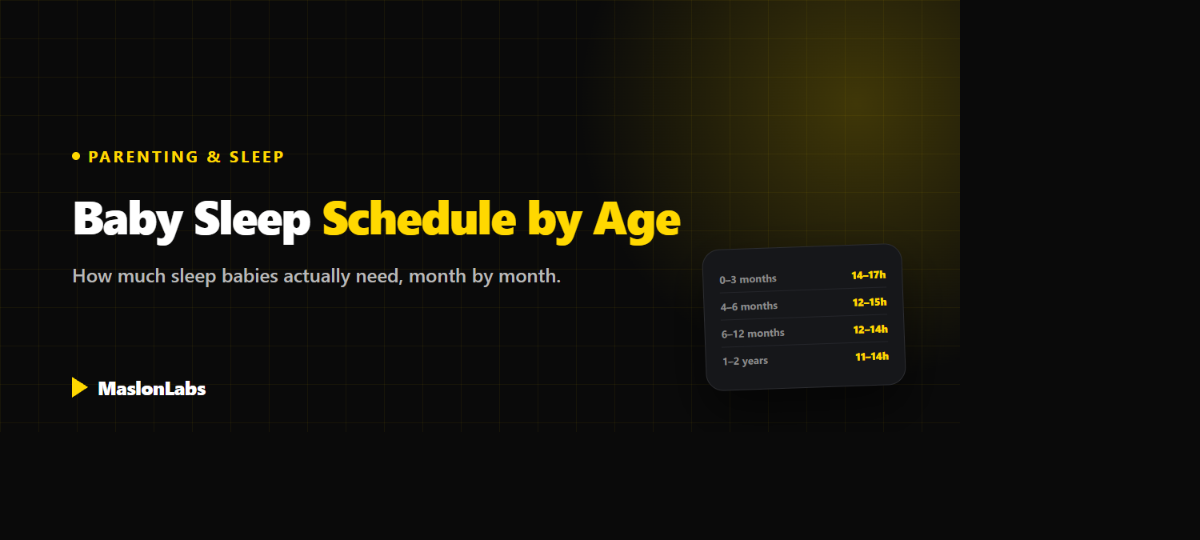
Sleep needs change fast in the first couple of years — what’s normal at 6 weeks looks nothing like what’s normal at 6 months. Here’s a general breakdown of typical sleep by age, so you know roughly what to expect at each stage.
Looking for calmer, easier nights with your baby?
Try Baby Sleep by MaslonLabs →Why Sleep Needs Change So Fast in the First Year
A baby’s sleep architecture is still developing — the ability to sleep in longer, more consolidated stretches builds gradually as circadian rhythms mature over the first several months. That’s why a rigid schedule rarely works for very young babies, and why the ranges below are guidelines, not rules.
0–3 Months (Newborn)
- Total sleep: roughly 14–17 hours across 24 hours.
- Pattern: short, unpredictable stretches (often 2–4 hours) around the clock, with no real day/night distinction yet.
- What’s normal: frequent night waking for feeding is expected, not a sign of a problem.
4–6 Months
- Total sleep: roughly 12–15 hours.
- Pattern: a day/night rhythm usually starts forming; naps often consolidate into 3–4 a day.
- What’s normal: this is when the well-known “4-month sleep regression” often occurs — a temporary disruption tied to developmental changes.
6–12 Months
- Total sleep: roughly 12–14 hours.
- Pattern: typically 2–3 naps a day; many babies begin sleeping longer overnight stretches (6–8+ hours).
- What’s normal: separation anxiety around 8–9 months can temporarily disrupt settling, even in babies who were sleeping well.
1–2 Years
- Total sleep: roughly 11–14 hours.
- Pattern: most toddlers drop to 1 nap a day somewhere in this window.
- What’s normal: nap transitions (2 naps to 1) often come with a rough adjustment period of a week or two.
2–3 Years
- Total sleep: roughly 10–13 hours.
- Pattern: typically 1 nap, gradually shortening as some toddlers begin dropping naps entirely closer to age 3.
Baby Sleep by Age: Week-by-Week and Month-by-Month
The broader ranges above are useful for context, but sleep changes fast enough in the first year that it helps to see it broken down more finely. Here is a closer look, week by week for the newborn stretch and month by month after that:
| Age | Total Sleep | Typical Naps | Longest Night Stretch |
|---|---|---|---|
| 1–2 Weeks | 16–18 hrs | Around the clock, no real pattern | 2–4 hrs |
| 3–4 Weeks (1 Month) | 15–17 hrs | No consistent pattern yet | 3–4 hrs |
| 2 Months | 14–17 hrs | 4–5 naps | 4–5 hrs |
| 3 Months | 14–16 hrs | 3–4 naps | 5–6 hrs |
| 4 Months | 12–15 hrs | 3–4 naps | 5–6 hrs (regression may disrupt this) |
| 5 Months | 12–15 hrs | 3 naps | 6–7 hrs |
| 6 Months | 12–15 hrs | 2–3 naps | 6–8 hrs |
| 7 Months | 12–15 hrs | 2–3 naps | 7–9 hrs |
| 8 Months | 12–14 hrs | 2–3 naps | 7–10 hrs |
| 9 Months | 12–14 hrs | 2 naps | 8–10 hrs |
| 10 Months | 12–14 hrs | 2 naps | 8–11 hrs |
| 11 Months | 12–14 hrs | 2 naps | 8–11 hrs |
| 12 Months | 11–14 hrs | 1–2 naps | 9–12 hrs |
| 18 Months | 11–14 hrs | 1 nap | 10–12 hrs |
| 2 Years | 11–14 hrs | 1 nap | 10–12 hrs |
| 3 Years | 10–13 hrs | 1 nap, or none | 10–12 hrs |
General guidelines, not medical advice — every baby varies. See a pediatrician with specific concerns.
Signs Your Baby Might Be Overtired or Undertired
- Overtired: wired, harder-than-usual to settle, short naps, more night waking than usual.
- Undertired: long time to fall asleep at bedtime, resisting naps entirely, unusually long stretches of happy awake time right before a sleep attempt.
Track It Without the Guesswork
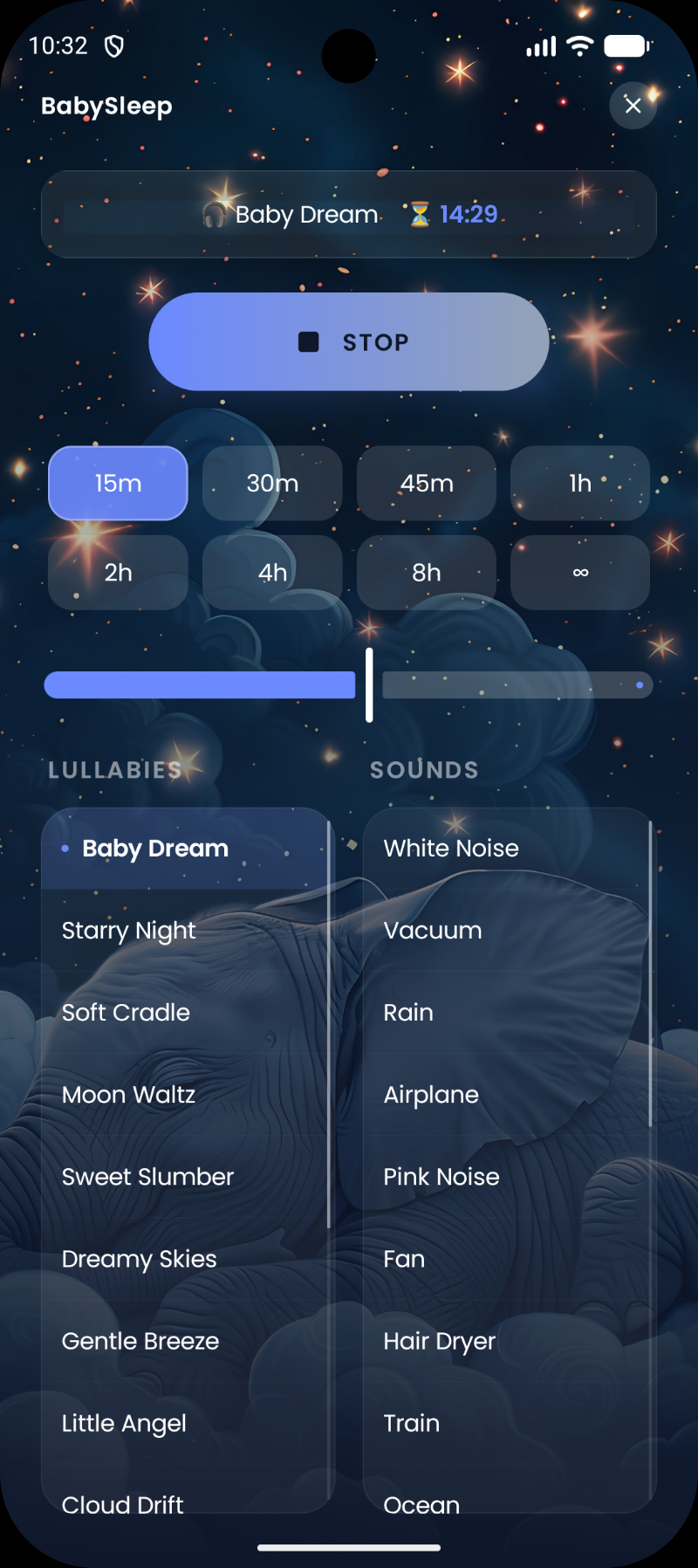
Whatever stage you’re in, a consistent sound-based routine can help reinforce the sleep habits above. Baby Sleep by MaslonLabs includes white noise, lullabies, nature sounds, and a built-in sleep timer, so the routine stays the same even as the schedule itself changes.
Want a consistent sound routine for every stage?
Get Baby Sleep by MaslonLabs →Full breakdown on our Baby Sleep app page, or get it on Google Play. Struggling with night wakings specifically? Read our guide on how to get your baby to sleep through the night.
Frequently Asked Questions
How much sleep does a 2-week-old need?
A 2-week-old typically needs around 16–18 hours of sleep across 24 hours, in short, unpredictable stretches with no real day/night pattern yet.
How much sleep does a 4-month-old need?
A 4-month-old typically needs around 12–15 hours of sleep, though this is also the age when the well-known 4-month sleep regression often temporarily disrupts things.
How much sleep does an 8-month-old need?
An 8-month-old typically needs around 12–14 hours of sleep, usually spread across 2–3 naps plus a longer overnight stretch of 7–10 hours.
How much sleep does a newborn need?
Newborns (0–3 months) typically need around 14–17 hours of sleep across a 24-hour day, spread across short, unpredictable stretches rather than one long block.
When do babies start napping fewer times a day?
Most babies gradually drop from 4 naps to 3, then to 2, and eventually to 1 nap somewhere between 6 months and 18 months, though the exact timing varies a lot between babies.
How much sleep does a 1-year-old need?
Around 11 to 14 hours total, usually made up of overnight sleep plus one or two daytime naps.
Is it normal for sleep needs to vary between babies?
Yes, significantly. These ranges are general guidelines, not strict rules — some babies consistently sleep at the higher or lower end of the range and are perfectly healthy.
What are signs my baby isn’t getting enough sleep?
Common signs include excessive fussiness, difficulty settling even when clearly tired, frequent short naps, and needing to be held or rocked to stay asleep. If you’re concerned, check with your pediatrician.
What app can help track a baby’s sleep routine?
Baby Sleep by MaslonLabs offers white noise, lullabies, nature sounds, and a built-in sleep timer, free on the Google Play Store.
These ranges are a starting point, not a diagnosis — every baby is different, and your pediatrician is always the best source for guidance specific to your child.